
How to buy an apartment in the EU from Ukraine without leaving: the complete sequence of steps

You can buy an apartment in the European Union while staying in Ukraine: the deal goes through by power of attorney or through a management company, the property is registered to your company, and rental and management run remotely.
There is one limitation, and it is not about the apartment but about the money: a bank in the European Union accepts only funds whose origin is confirmed by documents. That is why the route starts with checking the money, not with choosing a property.
In this sequence Romania is the answer, not the condition: completed buildings, installments from the apartment's owner, a management company under contract. Below is the complete sequence of steps, from the assessment to the residence card.
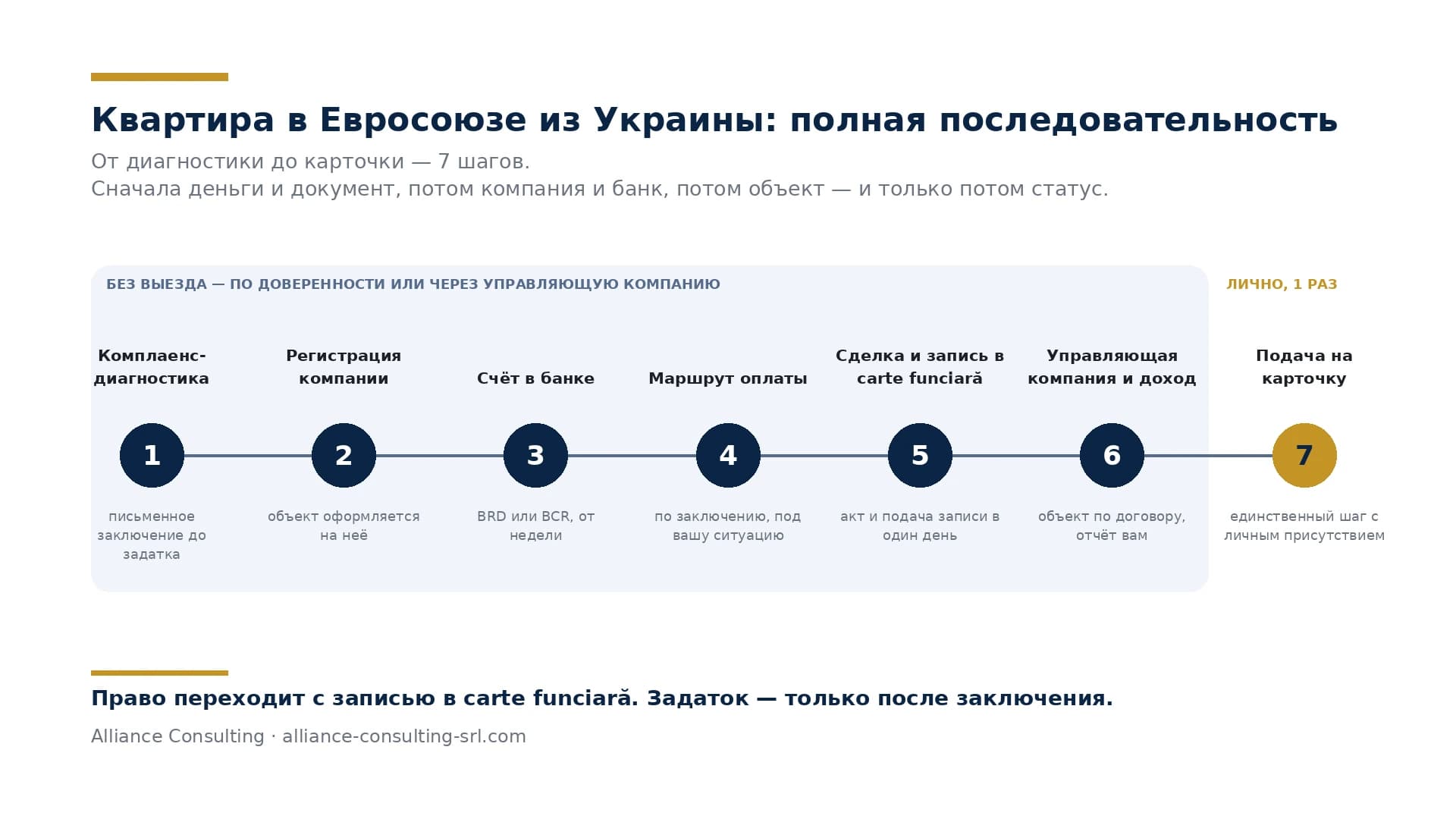
In short. The order is the same and does not change: first the money and the documents, then the company and the bank, then the property — and only then the status. The deal goes through by power of attorney; personal presence is needed once, and only when applying for the residence card. Entry is 30 % of the price: about €30,000 for a property of about €100,000, with the balance over 36 months interest-free. The installments are provided by the apartment's owner, not by a bank. A free compliance assessment with a written opinion is carried out before the deposit — the bank's answer is known in advance.
Can you buy an apartment in the European Union while in Ukraine
Yes. The deal goes through by power of attorney or through a management company; in person only if you wish. Personal presence is required 1 time — when applying for the residence permit, accompanied by a company specialist.
“Remotely” refers to the deal, not to the whole route. The power of attorney is drawn up for a specific deal, with a closed list of powers and a sworn translation into Romanian.
The management company acts under the client's power of attorney and manages the property after the deal. For a buyer who does not travel, these are not two different paths but one.
The complete sequence is 7 steps: Compliance assessment — Company registration — Bank account — Payment route — Deal and entry in the carte funciară — Management company and income — Applying for the residence card.
Where the purchase starts: checking the money and documents before the deposit
With a free compliance assessment and a written opinion: the recommended bank, the list of documents for the source of funds, an assessment of their origin, the timeline and the structure of the purchase. The deposit comes only after the opinion.
The bank's answer is known before the deposit, not after. For the initial review a short description is enough: where you are, who is buying — you or your company, your family, the purpose of the purchase, the budget and whether you have an operating business.
The opinion may be negative — with an explanation of why exactly the route does not work. That is also a result, and it costs less than any deposit. How the money check works is described on the banking compliance page.
The company is registered in parallel with the property search: until it is registered, the property cannot be put in its name. That is why the assessment, the registration and the search run simultaneously, not one after another.
What is checked in the property itself before the deposit — in a separate review.
How to pay for the purchase from Ukraine and what is allowed
Transferring private capital from Ukraine for investment abroad is closed by a ban with a list of exceptions. The payment route is determined during the assessment for the specific situation.
Resolution numbers, limits and expected relaxations are not given here: they change, and the opinion records the route as of a date.
Which documents prove the source of funds to the bank — in the review on the origin of funds.
What the bank checks and how long it takes
The origin of funds by documents: contracts, statements, tax returns. The bank, the notary and the specialized law firm are reporting entities before ONPCSB, Romania's financial intelligence unit.
An account at BRD or BCR — from one week. The decision is made by the bank; the company prepares the package to its requirements, and no one promises that the check will be passed.
The bank looks not at the buyer's integrity but at the chain: where the funds came from, what records it, whether the amount matches the document and whether there is a gap between the source and the account.
If a transfer for the deal is stopped, that is not a refusal but a procedure: the bank requests documents on the origin, and the answer is given within its timeline and in its format.
After the check the transfer is either released or returned. The second outcome is exactly why the assessment is done before the deposit.
How a deal by power of attorney works and what is executed on the day of payment
The notarial deed is signed on the day of the deal, and on the same day the notary files the entry in the carte funciară. Ownership passes with the entry — Articles 885 and 1676 of the Civil Code.
With installments, the seller's legal mortgage is registered until full payment — Articles 1723 and 2386. It is lifted with the last payment, by the seller's statement before a notary.
You are the owner from the date of the entry, not from the last payment. The building has been commissioned: not a construction pit and not a stage of completion — the property has cadastral documentation and an extract.
On the day of the deal 3 things are executed: the notarial deed under the power of attorney, the payment along the route from the opinion and the filing of the entry in the land register. The power of attorney with a sworn translation is prepared in advance.
How the day of the deal works step by step and what exactly is registered to the buyer on the day of payment — in two separate reviews.
How much entry costs and how the installments work
A property of about €100,000 is registered to the company. The 30 % payment — about €30,000 — includes notary fees and tax; nothing is paid on top of this amount on the day of signing.
The balance of about €70,000 — over 36 months interest-free, about €1,900 a month. The installments are provided by the apartment's owner, not by a bank: there is no loan application and no European-style income certificate.
Property — about €100,000, registered to your company; the building has been commissioned.
Payment — 30 %, about €30,000, including notary fees and tax.
Balance — about €70,000 over 36 months interest-free, about €1,900 a month.
Company registration — €1,300, about a month.
Residence permit support — €1,300, about three months, if this step is chosen.
Full cycle — up to four months; an account at BRD or BCR — from one week.
Standard TVA rate — 21 %; how it applies to a specific property and company is checked before the deal.
For scale: a comparable two-room apartment with a sea view in the European Union starts at €300,000. This is a market range, not a comparison of countries.
The management company runs the property under a contract with set timelines and amounts: preparation, tenant move-in, ongoing management, a report to the owner. Accounting is handled by specialized audit firms. What it costs to maintain the apartment after the purchase — in a separate review.
All services are provided under a contract that sets out the timelines, the amount and the working procedure. The company's licenses are publicly available on the website. Which tax regime suits the company — in the review on the micro-enterprise.
What to do if the money is already abroad or the purchase was made without a check
Money sitting idle in an account abroad — we start with the assessment and documenting its origin, not with the property.
An apartment bought in a personal name without a structure — there is ownership, but no fully legal income and no ground for a status. This is converted into a structure through a company.
A decision that turned out badly — can be fixed, and the sooner, the cheaper. In all three cases the review is the same: what is confirmed by documents, where the gap in the chain is and what is being restructured now.
What gets restructured is usually the same: the company, the lease agreement, legalizing the income, documents on the origin of the funds for the purchase. Sometimes the structure is completed in full, sometimes in part.
This is said plainly, before any new money goes in. Start with a free compliance assessment: it is carried out before the deposit and commits you to nothing.
The written opinion contains the recommended bank, the list of documents for the source of funds, an assessment of their origin, the timeline and the structure of the purchase. And a direct answer: whether this structure suits you.
The assessment may end in a reasoned refusal — that is also a result of the work.
Questions and answers
Do I need to leave Ukraine to buy an apartment in the EU?
For the deal — no: it goes through by power of attorney or through a management company. Personal presence is required once, when applying for the residence permit, and only if you choose this step. The power of attorney is drawn up for a specific deal, with a closed list of powers and a sworn translation into Romanian.
Does buying an apartment give a residence permit?
Not on its own. The ground is built as a chain: real estate owned by a company, rental, fully legal income, an employment contract, the residence card. The decision is made by the authority; the company prepares the documents and supports the application. You can also buy the apartment without this step: ownership and rental income exist regardless of your residence status.
What happens if the bank does not accept the origin of the funds?
You will learn this from the written opinion before the deposit — with an explanation of why the route does not work, and without any money paid. No one promises that the bank check will be passed: the decision is made by the bank. The purpose of the assessment is to get its answer before the deal, not after, when the money has already been paid.
Sources
Codul civil (Legea nr. 287/2009), Art. 885, 1676, 1723, 2386 — Portal Legislativ, Ministry of Justice of Romania
Legea notarilor publici şi a activităţii notariale nr. 36/1995 — Portal Legislativ, Ministry of Justice of Romania
Legea nr. 129/2019 privind prevenirea şi combaterea spălării banilor — Portal Legislativ, Ministry of Justice of Romania
Cadrul general — reporting entities and the reporting procedure — ONPCSB, Romania's financial intelligence unit
Author: Sergey Valentinovich Kononov, head of Alliance Consulting. Published: 12.08.2026. Updated: 02.10.2026.
Verified as of 01.10.2026. The legal points, amounts and timelines are current as of this date; the page is updated when they change.
Sergey Valentinovich Kononov is the head of the consulting company Alliance Consulting (Constanța, Năvodari). Over 30 years of management experience; the company has run a licensed practice in Romania for four years and supports clients from the first consultation to receiving their documents. The company's licenses and documents are publicly available on the website.