
Cryptocurrency as the source of funds for buying an apartment in the European Union: what the bank accepts and what it does not

A bank in the European Union accepts money from the sale of cryptocurrency as a source of funds — but only with a complete chain of documents: where the cryptocurrency came from, where it was exchanged for euros and how the income was declared. A sale to private individuals, cash and unlicensed platforms break the chain, and then that money does not go into the deal. Below is what exactly the bank accepts, which documents are needed, how the check runs and what to do if the trail is already gone.
In brief. A bank in the European Union accepts cryptocurrency as a source of funds only through a regulated exchange with documents: the wallet history from the first purchase, confirmation of the exchange on a platform authorized under the MiCA Regulation 2023/1114, and an income declaration in the country of residence. For a Russian citizen without a residence permit in the Union there is an additional rule: Article 5b of Regulation 833/2014 prohibits providing crypto-asset services to them in the European Union. A P2P sale, cash and unlicensed platforms are not accepted by the bank. The decision on the source always remains with the bank.
Does a bank in the European Union accept cryptocurrency as a source of funds?
It does — on two conditions: the exchange took place on a regulated platform and there are documents for it. A crypto-asset is a digital representation of value that is transferred and stored using distributed ledger technology; that is how it is defined by EU Regulation 2023/1114 on markets in crypto-assets, MiCA, which has applied in full since December 30, 2024.
A regulated platform is a crypto-asset service provider authorized under MiCA in a Union country: it has a supervisory authority, customer identification and reporting. An exchange on such a platform leaves a trail the bank can verify; an exchange outside it leaves none.
For a Russian citizen without a residence permit in the Union one more rule applies: Article 5b of Regulation 833/2014, as amended by Regulation 2025/2033, prohibits providing crypto-asset services to them in the European Union. The exception is citizens of Union countries and holders of a temporary or permanent residence permit. We draw the conclusion from this rule right away: a regulated exchange in the Union becomes available after the status, and the "status first" order applies here literally.
Which documents confirm cryptocurrency as a source of funds?
Three groups of documents: the wallet history, confirmation of the exchange and a tax declaration. The bank, the notary and other reporting entities in Romania work under Law 129/2019, with supervision by ONPCSB, Romania's financial intelligence unit; requesting these documents is mandatory for them.
Wallet history — addresses and transaction statements from the first purchase of cryptocurrency to the exchange: what it was bought with, with what money, when; the fiat entry is also confirmed by a bank statement.
Confirmation of the exchange — the regulated platform's report on the transactions, a document on its authorization, an account statement showing the incoming payment from the platform in your name.
Tax declaration — the income from cryptocurrency has been declared in the country of residence, and the tax has been paid or, as documented, did not arise; rates are not given here.
The link — amounts, dates and names in all three groups match each other and the contract for the property.
ONPCSB is the National Office for Prevention and Combating of Money Laundering, Romania's financial intelligence unit. A foreigner with a cryptocurrency source goes through the same procedure with reporting entities as any non-resident, only with a longer chain.
How does the bank check a cryptocurrency source?
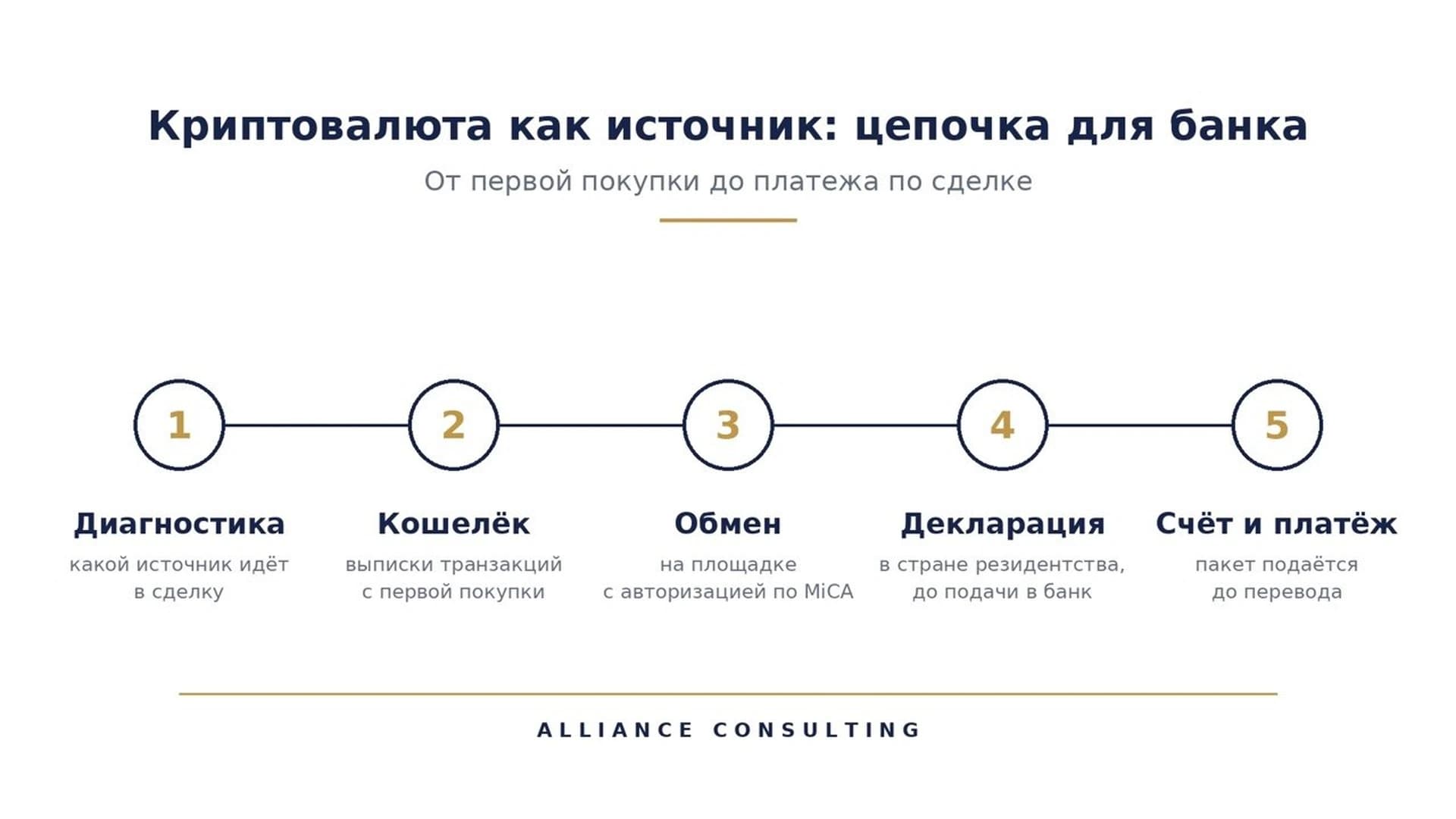
Along the chain from the first purchase to the arrival of euros in the account, link by link. The bank reconciles the fiat entry with the statement, the movement on the wallet with the platform's report, the incoming payment from the platform with the account, and the amount with the declaration and the contract for the property.
Assessment — which source goes into the deal and whether there is a complete chain for it.
Wallet history — transaction statements from the first purchase, the fiat entry confirmed.
Exchange on a regulated platform — the platform's report and its MiCA authorization.
Income declaration — in the country of residence, before submission to the bank.
Account and payment — the package is submitted before the transfer, and the incoming payment from the platform goes to your account.
How much time should you allow for the check of a cryptocurrency source?
More than for any other source of funds. In Alliance Consulting's advisory practice, the bank takes longer to check a cryptocurrency chain than a salary or the sale of an apartment: under Romanian Law 129/2019 the check is the same, but there are more links — wallet, platform, exchange, declaration — and each is reconciled separately.
The time is made up of three parts: assembling the chain before submission, the check at the bank and answers to requests for additional information. The client shortens the first part themselves — with a complete package the first time. Each request for additional information adds time: the bank waits for a reply and does not continue the check.
We do not name a number of days and do not promise timelines: they depend on the bank, the amount and the completeness of the history, and the decision on the source is made by the bank. That is why the package is submitted before the transfer and before the payment deadline under the deal, the property is reserved after the source has been accepted, and correspondence with the bank is conducted in writing.
What does the bank not accept as confirmation of cryptocurrency?
Three things: a P2P sale, cash and unlicensed platforms. P2P is an exchange of cryptocurrency directly between private individuals, without a regulated intermediary; such a deal has no platform report, no identification of the other party and no trail the bank could verify.
Accepted.
An exchange on a platform authorized under MiCA — the bank sees the platform's report, the authorization and the incoming payment to the account; accepted with a complete chain.
Not accepted.
A P2P sale to a private individual — the bank sees a transfer from an unknown person without a report.
Cash for cryptocurrency — the bank sees a cash deposit without a source.
A platform without a license in the Union — the bank sees an incoming payment from an unauthorized provider.
A gift from a private individual — the bank sees a transfer without a source.
We draw the conclusion right away: a platform report cannot be "backdated" — only the platform issues it, from its own records, and forging such a document closes not the deal but the client.
The cryptocurrency was sold via P2P and there is no trail — what should you do?
Start with what can be restored: the history at the platform where the cryptocurrency was bought or held, and the wallet statements. A regulated platform issues a report on transactions from its own records, the wallet statements show the path from the first purchase to the sale, and the fiat entry is confirmed by a bank statement.
One link cannot be restored — the exchange for euros itself via P2P. A private individual has no report, and the bank sees their transfer to your account as an incoming payment without a source. If this link cannot be closed with documents, the money from such a sale does not go into the deal.
After that, the assessment looks for an alternative source: a salary, dividends, the sale of real estate with a clean payment, savings with a history. This is not abandoning the purchase but replacing a link the bank will not accept.
How does Alliance Consulting handle a client with a cryptocurrency source?
As a procedure with a named law and a named authority: the MiCA Regulation 2023/1114, Romanian Law 129/2019, ONPCSB — Romania's financial intelligence unit, Article 5b of Regulation 833/2014. The company works under a contract that sets out the timelines, the amount and the working procedure; the contract is concluded only with an individual. Offices in Constanța and Mamaia, licenses publicly available on the website.
A compliance assessment with a written opinion is a free review of your situation before any decisions: whether the status is attainable, whether there is a complete chain for the cryptocurrency source and which source will go into the deal if there is no chain. The first section of the opinion covers whether the status is attainable. The result is a route built out with the sequence, timelines and budget, or a reasoned refusal explaining why.
The order of work is strict: status first, then money, then the asset. Personal sanctions are an absolute boundary. And a straight answer: whether this structure suits you. The assessment is free, commits you to nothing and may end in a reasoned refusal explaining why.
Questions and answers
Will a bank in Romania accept money from the sale of cryptocurrency?
A bank in Romania will accept money from the sale of cryptocurrency if the exchange took place on a platform authorized under the MiCA Regulation 2023/1114 and there is a report for it, a wallet history and an income declaration. The decision remains with the bank; in Alliance Consulting's advisory practice such a source is checked longer and more strictly than a salary or the sale of real estate.
What should you do if the cryptocurrency was sold via P2P and there is no payment trail?
If the cryptocurrency was sold via P2P, the payment trail cannot be restored: a private individual has no report, and a transfer from them is an incoming payment without a source. The remaining history is documented — the fiat entry, the wallet statements, the declaration — and for the deal the assessment looks for another source: a salary, dividends, the sale of real estate with a clean payment.
Do you need to pay tax on cryptocurrency before buying an apartment in the European Union?
Tax on income from cryptocurrency must be paid in the country of tax residence before the package is submitted to the bank: the declaration is one of the three groups of documents the bank requests. Rates are not given here; they depend on the country and the year. The Russian side of the calculation is handled by a Russian specialist; Alliance Consulting handles the Romanian part of the procedure.
Sources
EU Regulation 2023/1114 on markets in crypto-assets (MiCA) — on EUR-Lex — of May 31, 2023, applies in full since December 30, 2024
Council Regulation (EU) 833/2014 on restrictive measures — current version on EUR-Lex — of July 31, 2014, as subsequently amended; crypto-asset services and the exemption for residence permit holders — Article 5b
Romanian Law 129/2019 on preventing and combating money laundering — consolidated text on the ONPCSB website — Monitorul Oficial No. 589 of July 18, 2019, in force since July 21, 2019
ONPCSB — National Office for Prevention and Combating of Money Laundering, official website — Romania's financial intelligence unit, the authority under Law 129/2019
Alliance Consulting — the "Free compliance assessment with a written opinion" page — a free review of the situation before the deal with a written opinion
Author: Sergey Valentinovich Kononov, head of Alliance Consulting. Published: 30.09.2026. Updated: 30.09.2026.
Verified as of 24.09.2026. The legal points, amounts and timelines are current as of this date; the page is updated when they change.