
A second property in the EU: how a resident of one EU country buys an apartment in another

A residence permit in one EU country opens up buying an apartment in any other: the status lifts the banking restrictions tied to a Russian passport, the account is opened as for a resident, and the deal goes through without you being present. Below: what changes with the status, why the second purchase is not made where the residence permit is, how payment works between two EU countries and how to own an apartment from another country.
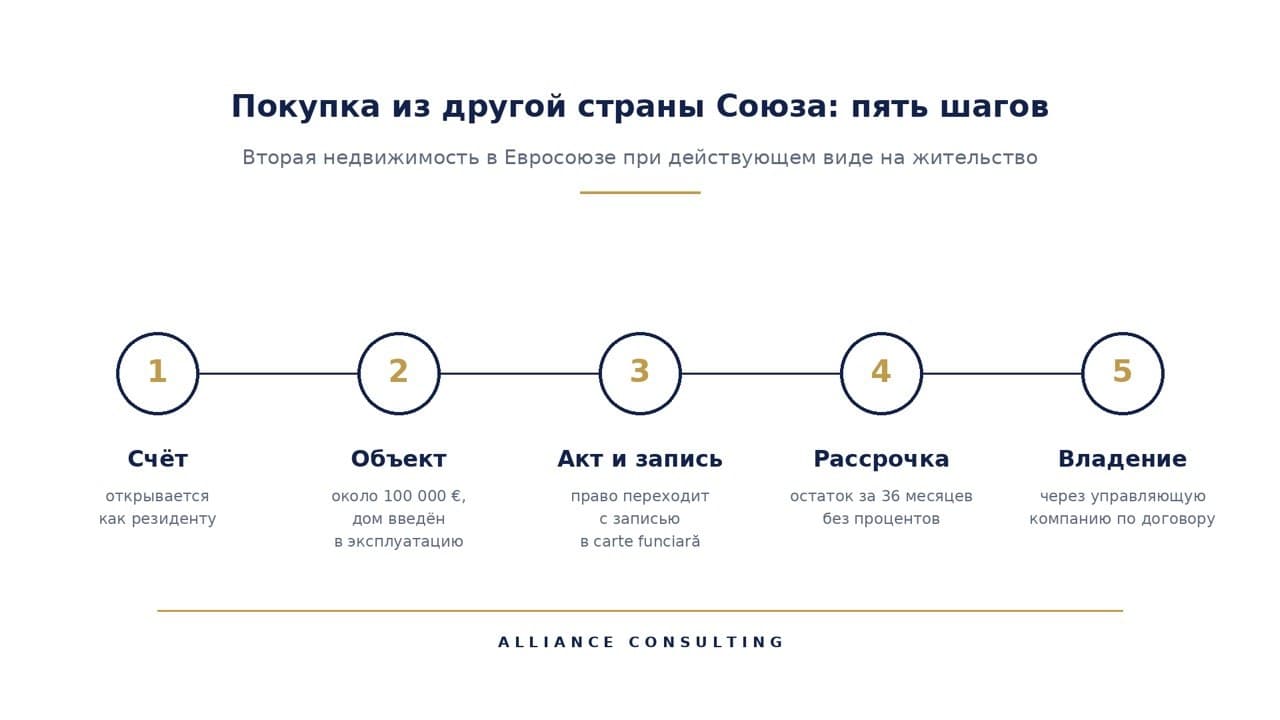
In short. A resident of one EU country holding a Russian passport buys an apartment in another EU country on general terms: the deposit cap and payment restrictions under Article 5b of Regulation 833/2014 do not apply to residence permit holders. A purchase without a bank: a property of about €100,000, a 30% down payment, the balance over 36 months interest-free — on confirmed terms as of September 1, 2026. The deal is done in person, by power of attorney or through a management company, and title passes with the entry in the carte funciară.
1. What changes once you already have an EU residence permit?
The banking restrictions tied to a Russian passport stop applying. Article 5b of Council Regulation (EU) 833/2014 of July 31, 2014, as currently amended, contains an exemption for holders of a temporary or permanent residence permit in an EU country: neither the deposit cap nor the ban on payment services applies to them.
The account is opened as for a resident, not as for a foreigner without status: no balance threshold and no restrictions on payment instruments. The source-of-funds check remains, but it follows the standard procedure rather than the enhanced one. The caveat that follows from the rule is stated up front: the exemption applies for as long as the status document is valid.
The asset jurisdiction in which Alliance Consulting handles the deal is Romania. Here a non-resident holding a residence permit from another EU country buys an apartment on the same terms as a foreigner with any status: ownership is registered to an individual, and there are no nationality restrictions.
2. Why is the second purchase made in another country rather than where the residence permit is?
Because of the entry price and an installment plan without a bank. On confirmed terms as of September 1, 2026, a two-room apartment with a sea view in Constanța costs about €100,000, while a comparable apartment elsewhere in the EU starts from €300,000. The down payment is 30%, about €30,000 including notary fees and tax.
The balance of about €70,000 is paid over 36 months interest-free — about €1,900 a month. The installment plan is offered by the apartment's owner, not by a developer, and this is about the price level, not a discount: the building has been commissioned, so this is not about a construction site.
The bank route does not come up in this structure at all: Romanian banks do not grant mortgages to non-residents, and a bank where you hold your residence permit will not lend against an apartment in another country. The purchase is paid with your own money and an installment plan from the owner.
3. Can you buy an apartment in another EU country without traveling there?
Yes, in three ways: in person, by power of attorney or through a management company acting under your power of attorney. All three lead to the same result — a notarial deed and an entry in the carte funciară on the day of the deal. The carte funciară is Romania's land register, the state register of property rights, kept by the ANCPI agency.
In person. Who signs the deed: you, at a notary in Romania. What is needed from you: coming for the one day of the deal. When it fits: if you want to see the property and the notary yourself.
By power of attorney. Who signs the deed: your representative under a notarized power of attorney. What is needed from you: a power of attorney made before a notary where you live, legalized if required. When it fits: if you have a trusted person in Romania.
Through a management company. Who signs the deed: the management company under your power of attorney. What is needed from you: an agreement and a power of attorney; everything else is remote. When it fits: if the property will be rented out and managed by you from another country.
A management company is a company that, under an agreement and the client's power of attorney, handles the deal, preparation of the property, finding a tenant and day-to-day management. The three options are always presented together: in any of them, the deal is registered to the client, not to the intermediary.
4. How does payment work between two EU countries?
By a euro transfer from your account in the country of your residence permit to your account in Romania, and from there to the seller through the notary. A cross-border euro payment within the EU costs the same as a domestic one — Regulation 924/2009 on cross-border payments, as amended by Regulation 2019/518, applicable since December 15, 2019.
An account in Romania can be opened in as little as a week at BRD or BCR — on confirmed terms as of September 1, 2026; the down payment and the subsequent installment payments go into it. The receiving bank checks the source of funds under the standard procedure: the sale and purchase agreement explains the purpose, and statements from your country of residence explain the origin.
Ownership passes with the entry in the carte funciară — Articles 885 and 1676 of the Romanian Civil Code, Law 287/2009, in force since October 1, 2011. The seller's legal mortgage is an encumbrance on the apartment in favor of the seller until the price is paid in full, Articles 1723 and 2386 of the same code; it is registered on the day of the deal and lifted with the last payment.
5. How do you own an apartment from another EU country?
Through a management company under an agreement, with the income paid into your account. The full cycle from the assessment to the entry in the carte funciară takes up to four months — on confirmed terms as of September 1, 2026; after that the property runs without you being there.
preparing the property, finding a tenant, the lease agreement, current payments — under a management agreement setting out the timelines, the fee and the procedure;
rental income — to your account in Romania or in the country of your residence permit, by a euro transfer within the EU;
tax on rental income is paid where the property is located — the procedure and documents are covered on a separate page of the cluster; rates are not given here;
utility bills and property tax go through the management company, with reporting under the agreement.
Rental rates and yields are not named in this article: they are calculated for a specific property during the assessment.
6. Looked for a mortgage where your residence permit is instead of an owner installment plan — what now?
Stop looking for a loan and go back to the installment plan from the owner. Banks in Romania do not grant mortgages to non-residents, and a bank in the country of your residence permit will not accept an apartment abroad as collateral — in Alliance Consulting's practice these are two closed doors, and the second one opens neither with an income certificate nor with a good credit history.
There is one route: an installment plan from the owner with the seller's legal mortgage under Articles 1723 and 2386 of the Romanian Civil Code. The seller is protected by the encumbrance until the last payment, and you are protected by the registration of your title in the carte funciară from day one. No interest is charged; the term and the schedule are set out in the notarial deed.
What to do now: if the property has already been chosen and a deposit has been paid in anticipation of a loan, the assessment is needed before the next payment falls due: an owner installment plan is put together in weeks, and the deposit is not lost when switching to it, provided the seller is ready for this kind of settlement.
7. How does Alliance Consulting handle a purchase when your status is in another EU country?
As a procedure with a named law and a named authority: the Romanian Civil Code, Articles 885, 1676, 1723 and 2386; registration of title — ANCPI, the National Agency for Cadastre and Land Registration. The company works under an agreement that sets out the timelines, the fee and the procedure; the agreement is concluded only with an individual. Offices in Constanța and Mamaia, licenses publicly available on the website.
A compliance assessment with a written opinion is a free review of your situation before any decisions: which account suits the deal, which documents from your country of residence are needed to show the source of funds, and which way of closing the deal to choose. The first section of the opinion covers whether the status is attainable; with a valid residence permit it is closed in one line. The result is a mapped-out route with the sequence, timelines and budget, or a reasoned refusal explaining why.
The order of work is strict: status first, then money, then the asset. Personal sanctions are an absolute boundary. And a straight answer: whether this structure suits you. The assessment is free, commits you to nothing and may end in a reasoned refusal explaining why.
Questions and answers
Can I buy an apartment in Romania if my residence permit is from another EU country?
You can buy an apartment in Romania while holding a residence permit in another EU country on general terms: the restrictions of Article 5b of Regulation 833/2014 do not apply to residence permit holders, and a foreigner's ownership of an apartment is not restricted by nationality. The deal is executed by you in person, by power of attorney or through a management company.
Do I need to open an account in Romania if I already have one in the country of my residence permit?
Yes, an account in Romania is needed: the down payment and the installment payments go into it, and from it the money goes to the seller through the notary. It can be opened in as little as a week at BRD or BCR — on confirmed terms as of September 1, 2026. Transfers between your two accounts within the EU are made in euros and cost the same as domestic ones under Regulation 924/2009.
Where is tax on rental income paid if I live in another EU country?
Tax on renting out an apartment in Romania is paid where the property is located, that is, in Romania, regardless of which EU country you live in. The procedure, the documents and the question of tax residence are covered on a separate page of the cluster; rates are not given in this article — they are calculated for your situation during the assessment.
Sources
Romanian Civil Code — Law 287/2009, republished, legislation portal legislatie.just.ro — Monitorul Oficial No. 505 of July 15, 2011, in force since October 1, 2011
ANCPI — Romania's National Agency for Cadastre and Land Registration, keeps the carte funciară — the authority's official website
Council Regulation (EU) 833/2014 concerning restrictive measures — current version on EUR-Lex — of July 31, 2014, as subsequently amended; the exemption for residence permit holders is Article 5b
Regulation (EU) 924/2009 on cross-border payments in the Union — on EUR-Lex — of September 16, 2009, as amended by Regulation 2019/518, applicable since December 15, 2019
Author: Sergey Valentinovich Kononov, head of Alliance Consulting. Published: 27.09.2026. Updated: 27.09.2026.
Verified as of 23.09.2026. The legal points, amounts and timelines are current as of this date; the page is updated when they change.