
What a European bank checks for a client with a Russian passport: enhanced due diligence, timelines, what speeds it up

Enhanced due diligence for a client with a Russian passport at a bank in the European Union is a standard procedure, not suspicion. The bank is required by law to carry it out, and it goes faster for those who bring a complete package the first time and conduct correspondence in writing. Below is what exactly the bank looks at, in what form it accepts documents, what the timeline depends on and what to do after a refusal.
In brief. A bank in the European Union carries out enhanced due diligence on a client with a Russian passport because of the law, not because of suspicion: in Romania the basis is Law 129/2019, with supervision by ONPCSB. The bank looks at four things: the source of funds, the connection to the jurisdiction, the purpose of the payment and the family composition. Documents are accepted with a translation and an apostille, current as of the date of submission. In Alliance Consulting's advisory practice the check takes from several days to several weeks; it is sped up by a complete package the first time, one bank instead of three and written correspondence.
1. Why is the check enhanced for a Russian passport — is it suspicion or procedure?
Procedure, not suspicion. Romanian Law 129/2019 on preventing and combating money laundering, in force since July 21, 2019, requires the bank to assess the risk of every client and apply enhanced measures where the risk is elevated. The sanctions framework around the Russian passport makes the risk elevated automatically, regardless of the client's identity and the amount.
Compliance is the mandatory check of a client and the origin of their money that the bank carries out by law before service begins and throughout the entire relationship. The bank does not choose whether to check or not: it only chooses how deeply.
The jurisdiction of the asset in which Alliance Consulting handles the deal is Romania. ONPCSB is the National Office for Prevention and Combating of Money Laundering, Romania's financial intelligence unit and the supervisory authority under Law 129/2019. The bank, the notary and other reporting entities work under the same law: a request for documents from each of them is mandatory, and its absence should worry you more than its presence.
The sanctions framework — the deposit limit and the payment restrictions — is covered on separate pages of the cluster and is not repeated here. One rule never changes: personal sanctions are an absolute boundary, and no work of any kind is done with a person on the lists.
2. What exactly does the bank look at for a client with a Russian passport?
Four things, and all four at the same time: the source of funds, the connection to the jurisdiction, the purpose of the payment and the family composition.
Source of funds — where the money comes from and what path it has taken: a contract, a declaration, statements. Separately — the source of wealth: how the client earns money in general, not only where the specific amount came from.
Connection to the jurisdiction — why the client needs an account in this country: a status, a contract for a property, a company, family. An account "just in case" does not pass the check.
Purpose of the payment — what the account is opened for and where the money will go: a sale-purchase or reservation agreement, the notary's bank details, an amount matching the contract.
Family composition — spouse and children: whose money is in the deal, whether there are politically exposed persons among close relatives, who will use the account. This is not curiosity but part of the beneficial owner check.
We draw the conclusion from this right away: none of the four points can be "left out" — an omission reads as a gap, and a gap reads as a refusal.
3. Which documents are requested and in what form are they accepted?
A package of three layers: identity and status, the origin of the money, the purpose of the account. As for the form — certified copies, a translation and an apostille where the document is foreign, and everything current as of the date of submission.
Identity and status: passport, a document confirming the status or visa, proof of address, tax residence per the bank's questionnaire.
Origin of the money: contracts, declarations, statements for the period, company documents — everything described on the page on the source of funds.
Purpose: the contract for the property, the recipient's bank details, the calculation of the amount.
Formalities: notarized copies, an apostille on foreign public documents, a translation by an authorized translator into Romanian or English — as required by the specific bank.
Validity period — in Alliance Consulting's advisory practice: statements and certificates are accepted when recent, as a rule no older than several months, and the bank will ask to update a package assembled six months ago. A foreigner in this procedure is no different from a non-resident of any other country, except for the depth of the request.
4. How long does the check take and what does the timeline depend on?
From several days to several weeks — in Alliance Consulting's advisory practice, without promises. The timeline depends not on the bank but on the package: a complete one the first time goes through quickly, an incomplete one goes around in a circle of requests.
Each request for additional information stops the clock: the bank waits for a reply, and the waiting time is the client's time. The second variable is consistency: if the statements do not match the contract, and the contract does not match the declaration, the bank asks questions about each discrepancy separately. The third is the channel: a written request and a written reply record the timeline, a phone conversation does not.
We do not name timelines in days: they differ between BRD and BCR, differ between branches and change with the risk policy. What does not change is the order: first the assessment and a complete package, then the submission.
5. What speeds up the check?
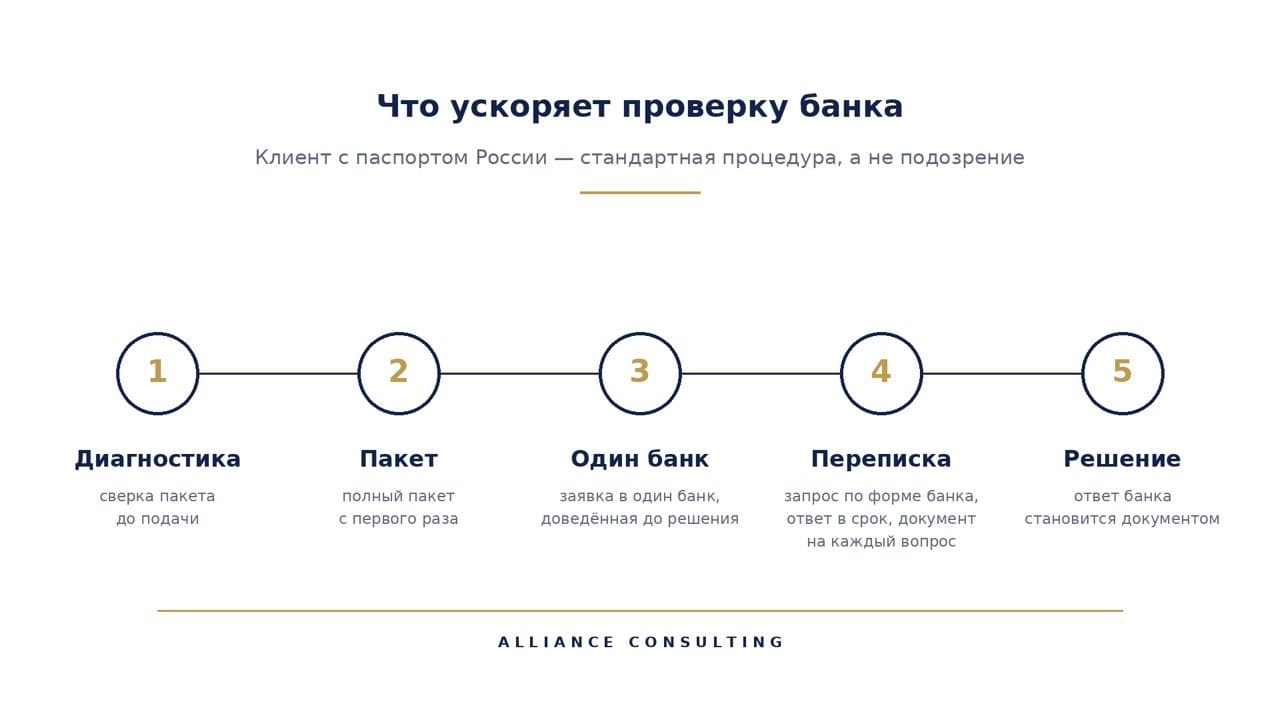
Three things: a complete package the first time, one bank instead of three and written correspondence.
A complete package the first time — assembled according to the bank's list, not by guesswork; checked for consistency before submission.
One bank instead of three — an application to one bank, taken through to a decision. Each new request is visible to the next bank, and parallel applications read as an attempt to find where fewer questions will be asked.
Written correspondence — a request in the bank's form, a reply on time, a document for every question. The bank's reply becomes a document; a phone conversation does not.
A fourth thing, often forgotten: reviewing the package before submission with someone who has seen dozens of such checks. That is exactly what the assessment is — it removes most requests for additional information before they appear.
6. A refusal without explanation — I applied to three more banks in a row. What should I do?
Stop and analyze the reason in writing. Multiplying applications is the worst move: each new refusal is visible to the next bank, and the fourth application starts with three refusals in the history.
An order of four steps:
a written request to the bank, in its form, about the reason for the refusal — the bank must state the ground, except in cases where Law 129/2019 prohibits it from disclosing details; even then the reply will show whether this is a documentary issue or not;
analysis of the ground: an incomplete package, a discrepancy in the chain, the deposit threshold, the absence of a status or the bank's own policy — each has its own fix;
correction before a new submission: the missing document, an updated statement, the route to the status;
one new application to one bank — with an explanatory note about the previous refusal and what has changed.
What does not work: submitting the same package to the next bank, explaining the refusal verbally and expecting the new bank "not to notice". It will notice — this is a standard procedure.
7. How does Alliance Consulting guide a client through the bank's check?
As a procedure with a named law and a named authority: Law 129/2019, ONPCSB — Romania's financial intelligence unit, the bank, the notary and other reporting entities. The company works under a contract that sets out the timelines, the amount and the working procedure; the contract is concluded only with an individual. Offices in Constanța and Mamaia, licenses publicly available on the website.
A compliance assessment with a written opinion is a free review of your situation before any decisions: whether the status is attainable, which documents the bank will accept for the source of funds and which bank fits your structure. The first section of the opinion covers whether the status is attainable. The result is a route built out with the sequence, timelines and budget, or a reasoned refusal explaining why.
The order of work is strict: status first, then money, then the asset.
It is worth starting with one question: have you already applied to any bank in the Union and how did it end. The answer determines whether the route starts with the package or with an analysis of the refusal. And a straight answer: whether this structure suits you. The assessment is free, commits you to nothing and may end in a reasoned refusal explaining why.
Questions and answers
Is it legal for a bank to refuse without stating the reason?
A refusal without a stated reason is legal in some cases: Law 129/2019 expressly prohibits the bank from disclosing details if the refusal is related to its obligations under this law. A written request in the bank's form is still needed: even a reply without details shows what the issue is — documents, the status or the bank's policy — and that determines the next step.
Will a bank in Romania accept documents in Russian?
A bank in Romania will not accept documents in Russian without a translation. A translation by an authorized translator into Romanian or English is required, along with an apostille on foreign public documents. The language of the translation and the form of certification differ between BRD and BCR, so they are clarified with the specific bank before submission, not after the first request for additional information.
Does the bank check the spouse if they are not involved in the deal?
The bank checks the spouse to the extent that concerns the beneficial owner: whose money is in the deal and whether there are politically exposed persons among close relatives. This does not mean the spouse needs their own package of documents. It means the answers about them must be ready in advance and match the documents already in your package.
Sources
Romanian Law 129/2019 on preventing and combating money laundering — consolidated text on the ONPCSB website — Monitorul Oficial No. 589 of July 18, 2019, in force since July 21, 2019
ONPCSB — National Office for Prevention and Combating of Money Laundering, official website — Romania's financial intelligence unit, the authority under Law 129/2019
Council Regulation (EU) 833/2014 on restrictive measures — current version on EUR-Lex — of July 31, 2014, as subsequently amended, including Regulation 2025/2033
Alliance Consulting — the "Banking compliance" service page — support with bank checks and compliance in transactions
Author: Sergey Valentinovich Kononov, head of Alliance Consulting. Published: 27.09.2026. Updated: 27.09.2026.
Verified as of 23.09.2026. The legal points, amounts and timelines are current as of this date; the page is updated when they change.