
A second jurisdiction for a family from Russia: account, company, asset and ground — in what order to assemble them

A second jurisdiction for a family is a structure of five elements in the European Union: a ground for status, an account, a tax number, an asset and, if needed, a company. It rests on the order of assembly, not on the amount: a structure assembled starting from the asset falls apart at the bank's very first question. Below is what it consists of, why the order is strict, how long it takes and what it gives the family.
In short. A second jurisdiction for a family from Russia is assembled in the European Union in a strict order: first status, then money, then the asset. The ground is a permit for international remote work under Spain's Law 14/2013 as amended by Law 28/2022; it lifts the banking restrictions under Article 5b of Regulation 833/2014. The account, the tax number and the company are set up after the status, and the asset comes last. In Alliance Consulting's support practice the structure takes several months and starts long before the documents are filed.
What is a second jurisdiction and what is it not?
A second jurisdiction is a country in which the family has a lawful ground to live, an account, a tax number and an asset, held in their own name and declared in both countries. In Alliance Consulting's product line the jurisdiction of status is Spain, and the jurisdiction of the asset is Romania.
What it is not: a way to make money invisible to the country of residence, or a substitute for the tax obligation at home. Both countries see the structure in full — the exchange of information between tax authorities is in place — and it is stable precisely because it has nothing to hide.
The subject of the article is the structure and its stability, not the size of the capital. Personal sanctions are an absolute boundary: no work of any kind is done with a person on the lists.
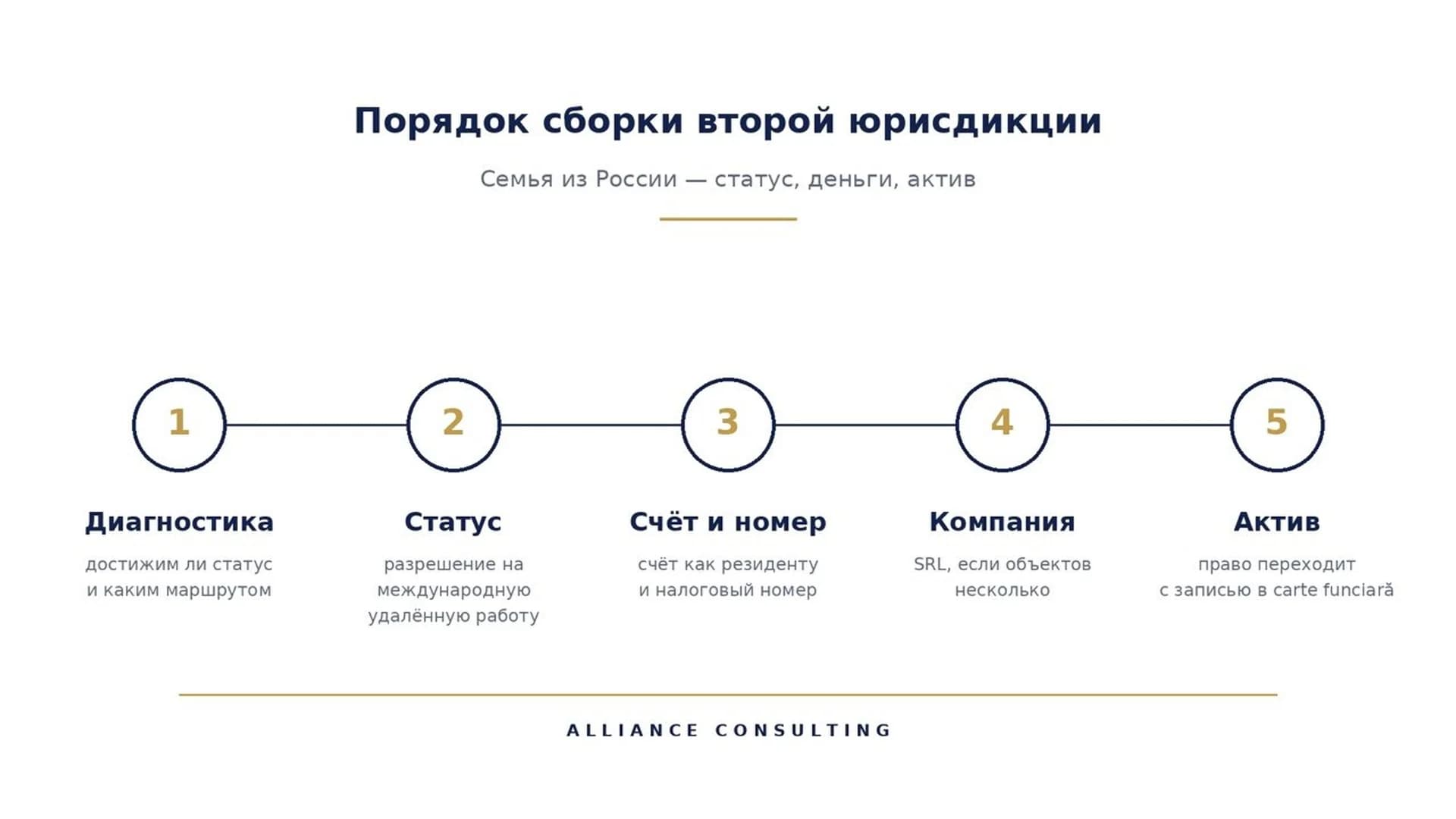
What does a second jurisdiction consist of: account, asset, tax number, company, ground?
Of five elements, and each has its own place in the queue. The ground comes first: a permit for international remote work under Spain's Law 14/2013 as amended by Law 28/2022, in force since December 23, 2022; the decision is made by UGE-CE, the unit for large companies and strategic categories.
Ground — status in an EU country; without it the other four elements do not hold.
Account — opened after the status, as a resident: the Article 5b exemption of Regulation 833/2014 for holders of a residence permit lifts the deposit limit and the payment restrictions.
Tax number — the NIF from ANAF in the country of the asset. The NIF is a non-resident's identification number in Romania's tax system; without it neither the deal nor the tax return goes through.
Company — an SRL, if there are several properties or the income comes through management. An SRL is a limited liability company under Romanian law; registration takes about a month and costs €1,300 under the terms confirmed as of September 1, 2026. The company does not give status.
Asset — an apartment owned by an individual or by a company; the right passes with the entry in the carte funciară — Articles 885 and 1676 of the Romanian Civil Code.
Why is the order of assembly strict: status, money, asset?
Because each next element is checked by the previous one. A bank opens an account for a resident, not for a foreigner without status; a notary completes the deal with money from an account, not in cash; ANAF registers income by tax number, not by passport. The reverse order runs into the very first check.
Status first.
Account — opened as a resident, with no balance threshold.
Payment for the deal — goes from your own account in the EU.
Income from the asset — registered under a resident's tax number.
Stability — each element confirms the next.
Asset first.
Account — a deposit threshold and payment restrictions by passport.
Payment for the deal — runs into a bank refusal or a returned transfer.
Income from the asset — an owner without status and without an account for the income.
Stability — the structure is rebuilt from scratch through an assessment.
The conclusion from the comparison, stated right away: the order is not sped up by buying the asset “while the property is available.” A property is reserved when the money can reach it, and in no other way.
How long does the structure take and why does it start long before filing?
Several months — based on Alliance Consulting's support practice, with no promises. The longest element is the ground: the law gives UGE-CE 20 working days for a decision, but the package for it is assembled in advance — a contract of at least 3 months, an employer company at least 1 year old, income, insurance.
After that the timelines are shorter: an account at BRD or BCR — from one week after the status, SRL registration — about a month, the full deal cycle up to the entry in the carte funciară — up to four months; all three under the terms confirmed as of September 1, 2026.
The route starts long before filing because filing is not the beginning but the middle: by then the work history, the contract and the documents on the source of funds must already come together. Whoever starts from the filing date loses months rebuilding the package.
What does a second jurisdiction give a family?
Lawful residence for the whole family, school for the children, medical care through insurance and travel across Schengen. The permit under Law 14/2013 is issued to the applicant and family members; in Spain children go to school on general terms, and medical care is provided through insurance from a Spanish insurer, which is part of the conditions of the status.
The limit is in the same paragraph: the permit does not give the right to be employed by a local employer — income remains from a foreign employer or clients, and for the self-employed the share of local sources is limited. An asset in Romania adds to this an account for the income and keeping money in euros, but not a second status: a Spanish residence permit does not give the right to live in Romania.
I bought the asset first and am now looking for a ground — what should I do?
Restore the order starting with an assessment, rather than picking a ground to fit an apartment already bought. An asset held by an individual without status is not a flaw in ownership but a structure without its first element: the property remains yours and the right is recorded in the carte funciară, but the account, the income and the payments around it run into restrictions by passport.
The order: the assessment determines whether a ground is achievable and in what timeframe; then the status; then the account as a resident and the tax number. After that the asset either stays with the individual, with the status and account added, or is moved into a structure through your own company — with the consequences of the transfer calculated before the deal, not after.
What does not work: looking for a ground “to fit the apartment” — an apartment does not give status; opening an account before the status — the payment will be rejected; waiting for the restrictions to lift on their own. The order is restored only from the first element.
How does Alliance Consulting assemble a second jurisdiction for a family?
As a procedure with a named law and a named authority: Spain's Law 14/2013 as amended by Law 28/2022 and UGE-CE — for the status; the Romanian Civil Code and ANAF — for the asset and the income. The company works under a contract that sets out the timelines, the amount and the working procedure; the contract is concluded only with an individual. Offices in Constanța and Mamaia, licenses publicly available on the website.
A compliance assessment with a written opinion is a free review of your situation before any decisions: whether the status is achievable and by which route, which documents are needed for the source of funds, whether a company is needed, in what sequence to assemble the elements. The first section of the opinion is whether the status is achievable. The result is a ready route with a sequence, timelines and a budget, or a reasoned refusal explaining the reason.
The working order is strict: first status, then money, then the asset. And a direct answer: whether this structure suits you. The assessment is free, commits you to nothing and may end in a reasoned refusal explaining the reason.
Can a family assemble a second jurisdiction in the European Union if it does not yet have a residence permit?
A second jurisdiction cannot be assembled without a residence permit — status comes first. There is one ground in Alliance Consulting's product line: a permit for international remote work under Spain's Law 14/2013 for those whose income comes from a foreign employer or clients. Whether it is achievable for your family is determined by the assessment.
Does buying an apartment in Romania give a residence permit in the European Union?
Buying an apartment in Romania does not give a residence permit: ownership and status are different elements of the structure. The right to the apartment passes with the entry in the carte funciară under Articles 885 and 1676 of the Romanian Civil Code, while status is given by the jurisdiction of the remote work permit. The order is the same — first status, then the asset.
Is a Romanian company needed to own a single apartment?
A Romanian company is not required for a single apartment: the property can be registered to an individual, and the income paid to a resident's account. An SRL makes sense with several properties or with management through a management company; registration takes about a month and costs €1,300 under the terms confirmed as of September 1, 2026. The decision is made during the assessment.
Sources
Spain's Law 14/2013 on support for entrepreneurs and their internationalization — consolidated text on BOE — of September 27, 2013, as amended by Law 28/2022 of December 21, 2022, in force since December 23, 2022.
EU Council Regulation 833/2014 concerning restrictive measures — current version on EUR-Lex — of July 31, 2014, as subsequently amended; the exemption for holders of a residence permit is Article 5b.
Romanian Civil Code — Law 287/2009, republished, Romania's legislation portal — Monitorul Oficial No. 505 of July 15, 2011, in force since October 1, 2011.
ANAF — Romania's National Agency for Fiscal Administration, official website — issues the NIF tax number to non-residents and administers income tax.
Alliance Consulting — the “Residence permit in Spain” service page — a residence permit in Spain based on a permit for international remote work.
Author: Sergey Valentinovich Kononov, head of Alliance Consulting. Published: 29.09.2026. Updated: 29.09.2026.
Verified as of 23.09.2026. The legal points, amounts and timelines are current as of this date; the page is updated when they change.