
SRL Taxes in Romania in 2026: Micro-Enterprise, 16% and Dividends

In 2026 the taxes for a Romanian company (SRL) changed noticeably. A micro-enterprise now pays a single 1% on turnover with a threshold of up to €100,000, other companies pay 16% on profit, and the dividend tax has risen to 16%. Below we look at which regime is more advantageous, how to withdraw profit correctly and which new restrictions you need to take into account so as not to lose money or the regime itself.
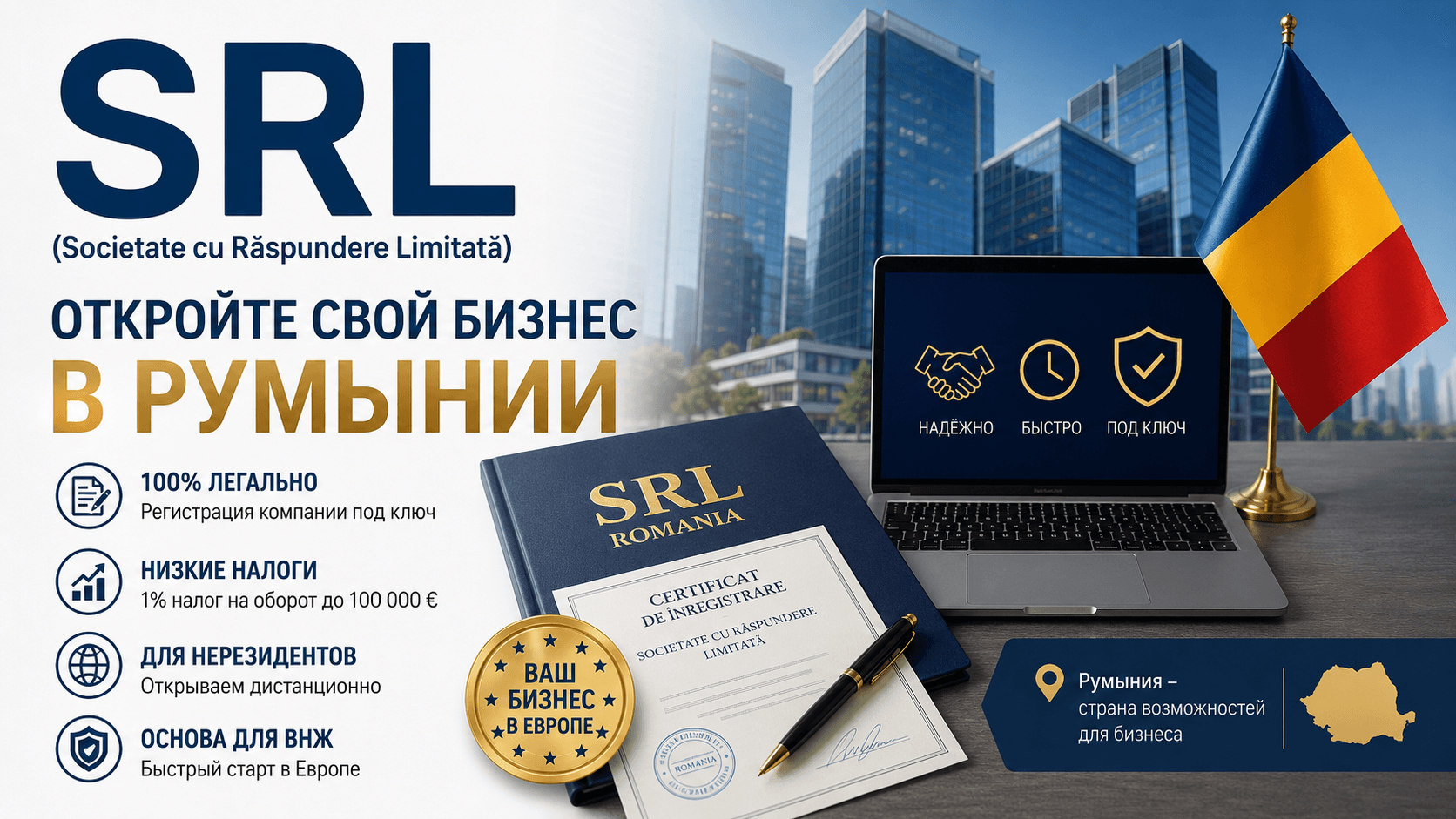
What an SRL is and why you need one
It is a Romanian limited liability company, the main form for doing business in the country. It can have one or several members (associates), and liability is limited to the contribution to the capital. For a foreigner, an SRL is two tools in one: a way to do business legally in the EU and a basis for a residence permit (as an administrator or associate). That is why it is important to set the company up under the right tax structure from the very beginning, rather than rebuilding it later once income appears. Romania is attractive for its combination of a low entry threshold and a relatively mild tax on small business, but from 2026 the rules have become stricter — and the cost of a mistake in choosing the regime has risen noticeably.
The main thing to understand: a micro-enterprise pays a percentage of turnover, while the standard regime pays on profit (income minus deductible expenses). For a high-margin business with low expenses, the micro regime is almost always more advantageous; for a business with large costs, the profit tax, where the base is smaller, may turn out to be more advantageous.
The main thing to understand: a micro-enterprise pays a percentage of turnover, and the standard regime pays on profit (income minus deductible expenses). For a high-margin business with low expenses, the micro regime is almost always more advantageous; for a business with large costs, the profit tax, where the base is smaller, may turn out to be more advantageous
Micro-enterprise in 2026: what has changed
The micro regime was noticeably tightened in 2026, and many companies that were “micro” in 2024–2025 no longer qualify for it.
• The threshold has been lowered from €250,000 to €100,000 of annual turnover (back in 2023 it was €500,000).
• The rate has become a single 1%; the higher 3% rate was abolished from January 1, 2026.
• At least one full-time employee with a permanent contract and a salary not below the national minimum wage is mandatory.
The regime is not available for banking, insurance, the capital market, gambling, or oil and gas extraction; a member with a stake of more than 25% may have no more than one micro-enterprise.
If turnover exceeds €100,000 during the year, the company automatically switches to the 16% profit tax from the quarter in which the threshold was exceeded. The tax authority (ANAF) must be notified of the change within 30 days, and you can return to the micro regime no earlier than the next financial year.
Dividend tax — 16% from 2026
This is the key change for everyone who withdraws profit from a company. From January 1, 2026, the dividend tax rate has been raised to 16% (in 2025 it was 10%, earlier — 8%). The tax is withheld at source by the company itself and applies to both individuals and legal entities. It applies to distributions made after January 1, 2026, regardless of the year for which the profit was earned.
For individuals who are tax residents, a CASS health contribution of 10% is additionally charged above the set thresholds. It is calculated not on the full amount but on fixed thresholds (6, 12 or 24 minimum salaries), which makes the burden predictable.
For non-residents, the rate may be reduced under a double taxation avoidance agreement. For example, for a tax resident of Ukraine the dividend rate may be approximately 15% — provided a tax residence certificate is submitted and the conditions of the treaty are met. Under the EU Parent-Subsidiary Directive, an exemption is possible with a stake of at least 10% held continuously for at least a year; dividends between two Romanian companies are not taxed under the same conditions.
How to withdraw money from the company: salary or dividends
Profit is usually withdrawn from an SRL in two ways — through salary and through dividends. A salary carries higher regular contributions (CAS, CASS, income tax), but it reduces taxable profit and counts toward your social insurance record. Dividends carry a 16% rate plus CASS when the thresholds are exceeded, but they are paid out of profit that is already being distributed.
There is no universal answer: the optimal combination depends on turnover, margin, the number of members and whether you need a social insurance record in Romania. That is why the way profit is withdrawn is calculated individually for a specific company — and it is at this stage that money is most often lost or saved.
A simple guideline: a company under the micro regime usually pays 1% on turnover plus payroll contributions for the mandatory employee, and the profit being distributed is taxed at 16% when dividends are withdrawn. Under the standard regime, 16% is first withheld on profit, and only then another 16% on dividends. That is why two businesses with the same turnover but a different cost structure can pay completely different amounts — and the choice of regime should be made on the numbers, not out of habit.
New restrictions in 2026
The reform added several rules that are easy to forget and get into trouble over.
Share capital: an SRL with annual turnover above RON 400,000 (about €80,000) must raise its capital to at least RON 5,000; a transition period until the end of 2027 is given for this, otherwise liquidation by court decision is possible.
Dividends cannot be distributed if the company’s net assets have fallen below half of the share capital — until they are restored.
Interim (quarterly) dividends cannot be distributed if there are uncovered losses or unfinished adjustments to previous distributions.
Transferring a controlling stake in an SRL requires notifying ANAF within 15 days and obtaining a tax certificate (certificat de atestare fiscală) before the change is registered in the Trade Register.
The link to the residence permit
An SRL is not only a business but also a basis for a residence permit in Romania. As an administrator or associate, you obtain the right of residence if the investment conditions are met, and after five years of legal residence long-term residence becomes available. That is why it makes sense to build the company and the tax structure with the status in mind from the start, especially if you are moving from temporary protection to a stable residence permit.
What to do if you have already made a mistake
A few typical situations that can be fixed if noticed in time.
If you opened an SRL counting on 1% but did not hire an employee, the company loses the right to the micro regime and is taxed at 16% on profit; the solution is to hire an employee on the terms set by law. If you withdrew dividends in 2026 without factoring in the new 16% rate and CASS, recalculate the burden to avoid additional assessments. If turnover went over €100,000 and the switch to profit tax has not been formalized, notify ANAF and recalculate the tax from the relevant quarter. If the share capital has not been raised with turnover above RON 400,000, do it within the transition period without letting it come to the risk of liquidation. The main rule: with Romanian taxes in 2026, it pays to fix the cause in advance rather than argue with ANAF after the fact.
What not to do
• open an SRL “just for show” without an employee, counting on 1% — you will not get the regime;
• withdraw dividends without factoring in the 16% rate and the CASS contribution;
• ignore the new limits on capital and net assets;
• transfer a stake in the company without notifying ANAF and obtaining a tax certificate.