
Romanian citizenship by ancestry for Russian citizens: who is eligible, enhanced scrutiny, genuine archives

An EU citizen’s passport by descent is a right confirmed by archives, not something you buy. For an applicant with a Russian passport, the route under Article 11 is the same as for all descendants of former Romanian citizens, while the document check is deeper and takes longer.
In brief. Romanian citizenship by ancestry is granted to descendants of former Romanian citizens up to and including the third generation — Article 11 of Law 21/1991. The ground is the ancestor’s Romanian citizenship, confirmed by archival documents. Since 15.03.2025 a B1 Romanian language certificate is required; under OUG 16/2026 it may be submitted later, until 14.03.2027. In Russian cases, after the investigation of December 2025, the authority cross-checks every document with the archive. The route to a passport takes 24–36 months based on Alliance’s support practice.
Who is eligible for Romanian citizenship by ancestry under Article 11 of Law 21/1991?
The right under Article 11 of Law 21/1991 on Romanian citizenship belongs to former Romanian citizens who lost their citizenship through no will of their own, and to their descendants up to and including the third generation: children, grandchildren, great-grandchildren. The citizenship of the country of residence is retained, and moving to Romania is not required. The ground is not ethnicity but the ancestor’s Romanian citizenship, confirmed by documents.
Article 11 is the provision on restoring citizenship to those who lost it against their will and on granting it to their descendants. The conditions are those of Article 8 of the same law: loyalty to the Romanian state, legal age, and no conviction for serious offenses.
The typical ground for a family from Russia is an ancestor from Bessarabia, Northern Bukovina or the Hertsa region: from 1918 to 1940 these territories were part of Romania, their inhabitants were Romanian citizens and lost their citizenship in 1940 when the territories passed to the USSR — against their will, as Article 11 requires.
The right to Romanian citizenship is confirmed by documents — and we take that right all the way to a passport. The decision is made by the authority: no result can be guaranteed, but the file can be assembled so that it raises no questions. Timelines, fee and the working procedure are set out in the contract.
Why is scrutiny of Russian cases enhanced, and what does it mean in practice?
Cases of applicants with a Russian passport are checked more deeply following an investigation by the Prosecutor General’s Office of Romania: on 18.12.2025 searches were carried out at 37 addresses in a case concerning Romanian citizenship restored or granted on the basis of forged official documents; according to the prosecutor’s office, most of those involved are Russian citizens. Since then, every archival document in such a case is cross-checked with the archive that issued it.
Autoritatea Națională pentru Cetățenie, ANC, is the National Authority for Citizenship under the Ministry of Justice of Romania: it accepts applications, examines files through the Citizenship Commission and issues citizenship orders. The Commission has the right to request information from any authorities and archives.
Every civil status record is confirmed by its source archive — the archive’s reply goes into the file.
The kinship chain is checked for every generation — a surname discrepancy is resolved with a certificate of identity.
Criminal record certificate from Russia — with an apostille and a sworn translation, requested last.
A forged document — refusal, the materials are sent to the prosecutor’s office, and citizenship already obtained is revoked under Article 25 of Law 21/1991.
This is a description of the procedure, not an obstacle: a genuine ground passes the check, a doubtful one does not. That is why Alliance Consulting works only with genuine archival documents.
Which documents confirm the line, and in which archives should you look for them?
The line is confirmed by three groups of documents. The first is proof of the ancestor’s Romanian citizenship: a birth or marriage record from the Romanian civil status register of 1918–1940, a Romanian passport, military documents. The second is the kinship chain: birth and marriage certificates for each generation down to the applicant. The third is the applicant’s own documents: passport, criminal record certificates, language certificate.
Bessarabia — the National Archives of the Republic of Moldova and the Public Services Agency in Chișinău.
Northern Bukovina and the Hertsa region — the State Archives of Chernivtsi Oblast, Ukraine; records from the Romanian period are written in Romanian.
Romania — the National Archives of Romania and their county directorates: part of the interwar registers.
Russia — the civil registry office at the place of birth of each generation: birth and marriage certificates.
Accepted: originals and archival extracts bearing the seal of the issuing archive, with a sworn translation and an apostille. Not accepted: copies with no stated source and “restored” records without a file number.
A single archival check covers both lines: if the ancestor is recorded as a Romanian citizen, the route is Romanian, under Article 11; if the records show the ancestor’s Bulgarian nationality, the route is Bulgarian.
Is a B1 certificate required, and until what date can it be submitted under OUG 16/2026?
A B1-level Romanian language certificate has been mandatory for applicants under Articles 10 and 11 since 15.03.2025: it was introduced by Law 14/2025, published in Monitorul Oficial No. 218 of 12.03.2025. You may file the application without the certificate: under emergency ordinance OUG 16/2026 of 12.03.2026 it may be submitted until 14.03.2027; otherwise the application is rejected as unsupported by order of the ANC president.
A language competence certificate is a document attesting to the level of Romanian proficiency; the list of accepted certificates and organizations is published by ANC. Instead of the certificate, the law accepts a certified copy of school records covering at least 3 years of study in Romanian — Article 15¹ of Law 21/1991.
Applicants who have turned 65 by the filing date are exempt from the certificate. For everyone else the window is open now: an application filed by 14.03.2027 is accepted without the certificate, and the exam is taken in parallel with the archival work.
How long does the route to a passport take — 24–36 months — and what makes it longer?
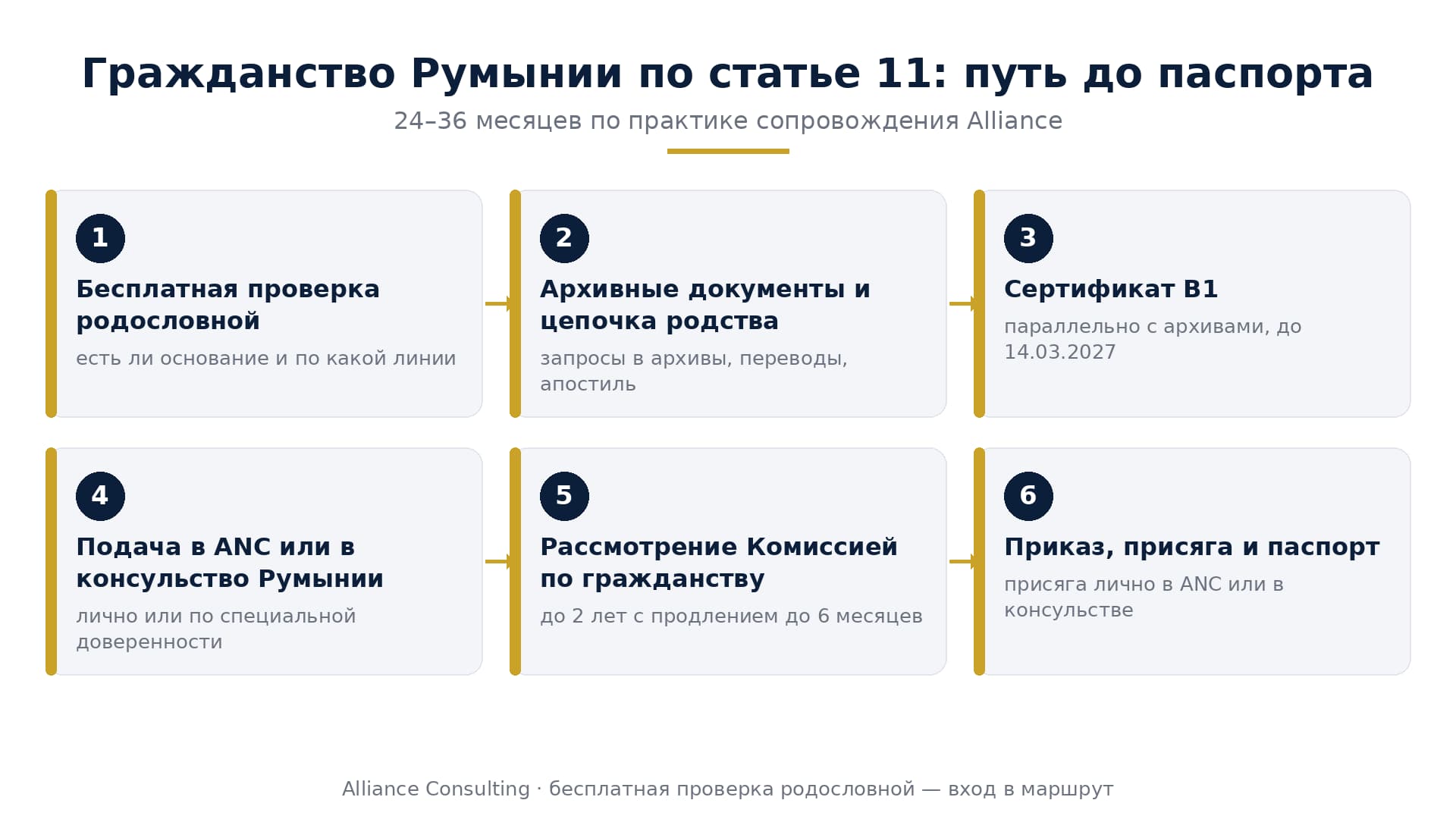
From the first conversation to the passport, the route takes 24–36 months based on Alliance’s support practice. Law 14/2025 gives ANC two years to examine a case, with a possible extension of up to six months. The oath is taken within one year of notification of the order, and citizenship arises on the day of the oath — Article 20 of Law 21/1991 as amended by Law 14/2025.
Stages of the route:
Free genealogical check — whether there is a ground and through which line.
Archival documents and the kinship chain — requests to archives, translations, apostille.
B1 certificate — in parallel with the archives, by 14.03.2027.
Filing with ANC or a Romanian consulate — in person or through a special power of attorney.
Review by the Citizenship Commission — up to 2 years, with an extension of up to 6 months.
Order, oath and passport — the oath is taken in person at ANC or at a consulate.
Three things make it longer: a gap in the chain, when one generation’s record is missing; name discrepancies between Russian and Romanian documents; an ANC letter requesting additional documents that goes unanswered. The stage of a case can be seen by its number — the procedure is explained in the article “How to check the status of a case with ANC”.
What should you do if an intermediary promised citizenship “by arrangement”, without archival documents?
Stop before filing and check the ground against the archives: there is no citizenship “by arrangement” in Romania; the decision is made by the ANC Citizenship Commission solely on the basis of documents. Since December 2025, a case built on dubious papers ends in refusal and a check by the prosecutor’s office, and citizenship obtained that way is revoked under Article 25 of Law 21/1991.
Three situations:
The money is paid, but you have not seen the documents — ask the intermediary for a copy of each document with the name of the archive and the file number. No file number means no document and no ground.
The case has already been filed on “found” papers — each document is checked through its source archive; if there is no confirmation, withdrawing the application before the Commission’s decision is considered.
The ground is genuine, but the intermediary was “speeding things up” — the file is rebuilt on genuine documents and filed again.
Alliance Consulting starts with a free genealogical check. If the archives hold no ground, you receive a written answer with the reason — a reasoned refusal — and you do not pay for a route that does not exist.
How does Alliance Consulting work, and where do you start?
Alliance Consulting handles the case under a contract with the individual: timelines, fee and the working procedure are written into it, and the company’s licenses are publicly available on the website. The entry point is a free genealogical check: a reply within 1 business day, a conversation of up to 30 minutes; the timeline for the archival check is given after the conversation.
Scope of work: requests to archives, verification of the kinship chain, translations and apostille, submission of the file, replies to ANC requests, the oath. The head of the company is responsible for strategy and coordination; the legal part is handled by specialists in the relevant field. More details are on the service page “Repatriation to Romania”.
An apartment and citizenship are two separate tracks: the ground for a passport comes from the archive, not from a purchase. A status for living in the European Union while the case is pending is built separately — see the hub “Real estate in the European Union for Russian citizens”.
Start with a free genealogical check. It is carried out before any decisions and commits you to nothing. You are left with a written answer: whether there is a ground under Article 11 and through which line, and which documents are missing; if there is no ground, a reasoned refusal stating the reason.
Questions and answers
Can a Russian citizen obtain Romanian citizenship by ancestry in 2026?
Yes, a Russian citizen can obtain Romanian citizenship under Article 11 of Law 21/1991 if an ancestor up to the third generation was a Romanian citizen and lost that citizenship through no will of their own. A Russian passport does not limit the right, but after the investigation of December 2025 every document is checked through its source archive; the route takes 24–36 months based on support practice.
Do you have to renounce Russian citizenship to get a Romanian passport?
No, you do not need to renounce Russian citizenship: Article 11 of Law 21/1991 expressly allows keeping a foreign citizenship and living outside Romania. Obligations toward Russian authorities arising from holding a second citizenship are a separate matter of Russian law; this is checked separately, as of the date of the oath.
Can documents for Romanian citizenship be filed without traveling to Bucharest?
Yes, applications under Article 11 are accepted both at ANC in Bucharest and at Romania’s consular missions — Article 13 of Law 21/1991; in justified cases a representative files under a special power of attorney. The oath is taken in person — at ANC or at a consulate. Which mission accepts the case depends on the applicant’s place of legal residence.
Sources
Legea nr. 21/1991 a cetățeniei române, republicată — as in force since 15.03.2025
Legea nr. 14/2025 pentru modificarea și completarea Legii cetățeniei române — Monitorul Oficial No. 218, 12.03.2025
Ordonanța de urgență nr. 16/2026 privind modificarea art. XXI din Legea nr. 14/2025 — Government of Romania, 12.03.2026
Anunț important: certificatul de competență lingvistică poate fi depus până la 14.03.2027 — Autoritatea Națională pentru Cetățenie, 16.03.2026
Author: Sergey Valentinovich Kononov, head of Alliance Consulting. Published: 05.10.2026. Updated: 05.10.2026.
Verified as of 05.10.2026. The legal points, amounts and timelines are current as of this date; the page is updated when they change.
Sergey Valentinovich Kononov is the head of the consulting company Alliance Consulting (Constanța, Năvodari). Over 30 years of management experience; the company has run a licensed practice in Romania for four years and supports clients from the first consultation to receiving their documents. The company’s licenses and documents are publicly available on the website.