An apartment in the EU for a Ukrainian: how to buy without citizenship and what it gives — step by step

Author: Sergey Valentinovich Kononov, head of Alliance Consulting
Published: 19.08.2026 · Updated: 25.09.2026
An apartment in the European Union is available to a buyer without EU citizenship: a foreigner acquires ownership of housing on an equal footing with a citizen, and entry starts from €30,000. There is one limitation, and it is a banking one: in practice, mortgages are not issued to non-residents in Romania — so what works is installments from the apartment's owner, secured by the seller's legal mortgage. You do not need to change your country of residence for this: your city, school, doctor and job stay where they are, and the deal goes through remotely. Below is what a non-resident buys, what the entry is made up of, what the apartment gives besides a home and what happens to it after
March 4, 2028.
Can a Ukrainian without EU citizenship buy an apartment in the European Union
Yes. EU citizenship is not required to buy housing: a foreigner acquires an apartment as property on the same terms as a resident and receives an extract from the land register in their own name. The difference concerns only land: a non-resident acquires a plot through a Romanian legal entity or on the basis of an international treaty, while a building can be acquired without restrictions. An apartment in a multi-unit building is a building plus a share of the land under it, so in practice the purchase is made directly, and the company is needed not for the deal itself but for income and a ground for status.
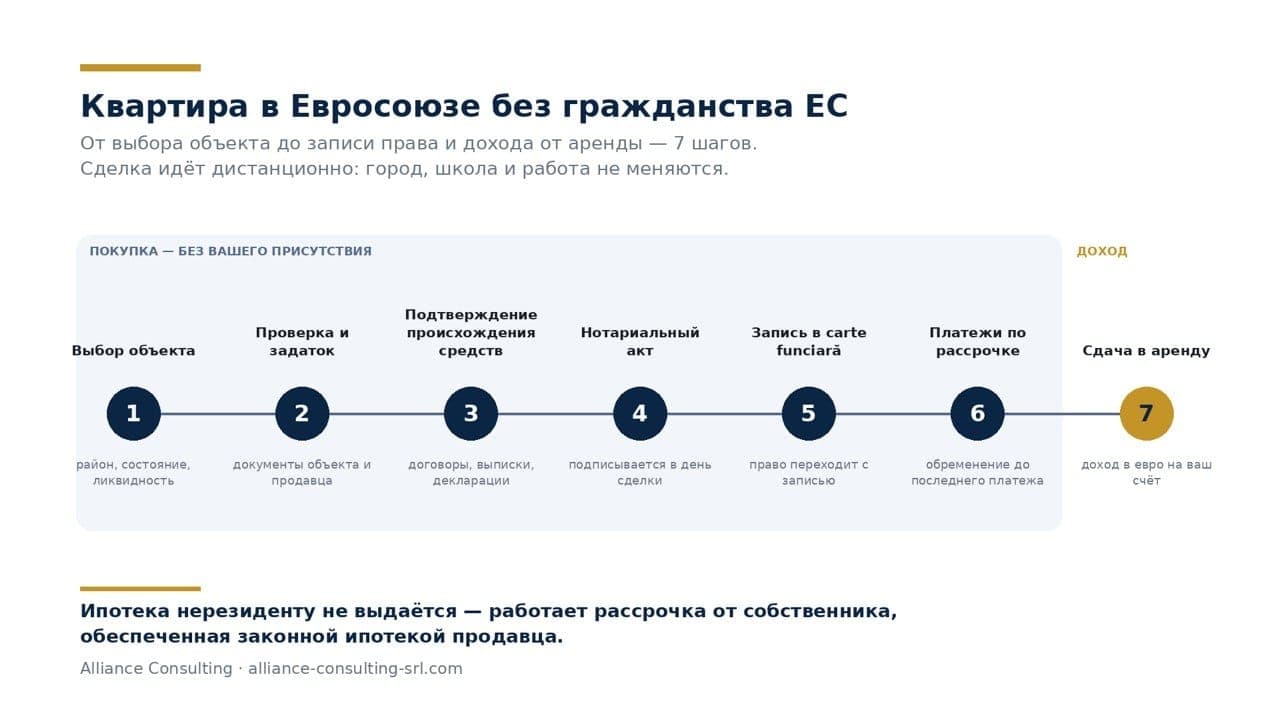
The complete sequence is 7 steps: Choosing the property, Check and deposit, Proof of the origin of funds, Notarial deed, Entry in the carte funciară, Installment payments, Renting out. The rights do not arise at the moment of a handshake: the notarial deed is signed on the day of the deal, the entry is filed the same day, and the right passes with the entry — Articles 885 and 1676 of the Civil Code.
How much entry costs and why without a bank
Entry into the deal starts from €30,000, and no bank is involved in this scheme.
In practice, a mortgage is not issued to a non-resident in Romania — this is not an obstacle but a fork in the road: instead of the credit route, what works is installments from the apartment's owner, secured by the seller's legal mortgage under Articles 1723 and 2386 of the Civil Code.
The encumbrance is registered in the land register until full payment and is lifted with the last payment. There is no loan application, no credit scoring and no European-style income certificate here — there is a contract and a schedule.
• A typical property — about €100,000.
• First payment — 30 %, about €30,000; it includes notary fees and tax, and nothing is paid on top of this amount on the day of signing.
• Balance — about €70,000 over 36 months interest-free, about €1,900 a month.
• A comparable two-room apartment with a sea view in the European Union — from €300,000.
• The full cycle with setting up the company and the status — up to 4 months.
This compares price levels, not countries: specific markets are not named here, because a property should be compared with a property, not a country with a country.
What the apartment gives besides a home: an asset, income, a ground
The apartment gives 3 things at once: property in the European Union, income in euros and a ground for status. Property is an entry in your name in the state register of an EU country, an asset that does not depend on how long your current residence permit is valid. Income is rental: the property is let, the lease is registered with the tax office and the money comes into your account; specific rates for a property are calculated separately, because they depend on the district, the condition and the rental mode. The ground is a chain, not the purchase itself: real estate owned by a company, rental, fully legal income, an employment contract, the residence card. There are no promises here: the decision is made by the authority, and the company prepares the documents.
You also do not have to deal with the property yourself — a management company runs it under a contract with set timelines and amounts: preparation, the tenant, day-to-day matters, a report to the owner; the cost depends on the package and is fixed in the contract.
How to prove the origin of thirty thousand
With documents, not explanations: the bank and the notary look at the chain by which the money appeared and reached the account. The origin is proven by contracts, statements, tax returns, documents on the sale of property, a gift, an inheritance. For a buyer living in another EU country, the usual picture is a salary and savings in local accounts, and that is precisely the simple case: a statement and a letter from the employer settle the question.
It is harder where the money came in several transfers from different people or is held in cash — then a history is assembled for each part of the amount. The bank, the notary and the lawyer report to Romania's financial intelligence unit, so the check is mandatory and the same for everyone. The decision is made by the bank; the package is prepared to its requirements, and no one guarantees it will pass.
You get the answer to this question before the deposit — in the written opinion of the assessment.
How to buy without changing your city, school or job
The purchase does not require moving: you stay where you live, work and take your children to school. The deal goes through remotely — by power of attorney to a representative or through a management company acting under your power of attorney; the power of attorney is notarized and translated by a sworn translator.
You need to come once, and only if you go as far as the residence card: submitting biometrics, accompanied by a company lawyer. Everything else — choosing the property, the check, the deposit, the payments, the signing, the registration, the tenant moving in — goes ahead without you being present.
This is the whole point of the structure for a person who has already settled their life in another EU country: an asset appears in the European Union, while daily life does not change.
What happens to the purchase after March 4, 2028
Nothing happens to the apartment: ownership is not tied to how long temporary protection lasts. The entry in the land register has no expiry, the property remains yours, rental income keeps coming in, and you can sell it or pass it on by inheritance regardless of your residence status.
The protection itself has been extended until March 4, 2028 — by EU Council Decision 2026/1912, in force since August 5, 2026. That is exactly the difference between an asset and a status: a status is granted for a term and renewed, while ownership exists permanently.
That is why the window for a calm decision is open now: your own ground is built in advance, in the normal way and with normal timelines, not in the last months when everyone is doing the same thing at once.
What to do if you have been renting for four years
A fourth year of renting means paying for someone else's square meters and owning nothing; this can be fixed at any time, and there is no need to start over. The usual picture: payments go out every month, the amount is comparable to an installment payment, but at the end of the year the tenant has no share in a property, no income and no ground for status — only receipts. Meanwhile, the lease can end at the owner's wish, and the terms are revised every year, not in your favor.
The turnaround — 4 steps:
1. We calculate what is already going out: the annual rent against the first payment and the installment payment; this is arithmetic, not persuasion.
2. We check the money: which documents prove the origin of the entry amount, what is missing and how to close the gap.
3. We choose the structure: buying in your own name or in the company's, then income and a ground; the option without status also works if you do not need the residence card.
4. A remote deal: handing the property over to management.
Start with a free strategic assessment — it is carried out before any decisions and commits you to nothing: a review of your situation, at least 2 routes, a budget and a sequence of steps. The assessment may end in a reasoned refusal — that is also a result. Write to us — we will review your situation.
Do you need a residence permit to buy an apartment in the European Union?
No. The purchase requires neither EU citizenship nor a residence permit: a foreigner acquires housing as property and receives an extract in their own name.
Status is a separate route, built as a chain through a company, rental and fully legal income.
Who provides installments if the bank refuses?
The apartment's owner. These are installments from the owner, secured by the seller's legal mortgage: the encumbrance is registered in the land register until full payment and is lifted with the last payment. No bank is involved in this scheme.
What happens to the apartment if the residence status ends?
Nothing. Ownership is not tied to the term of your residence permit: the entry in the register has no expiry, the property remains yours, the rental continues, and sale and inheritance are possible in the usual way.
Sergey Valentinovich Kononov is the head of the consulting company Alliance Consulting (Constanța, Năvodari).
Over 30 years of management experience; the company has run a licensed practice in Romania for four years and supports clients from the first consultation to receiving their documents. We work under a contract that sets out the timelines, the amount and the working procedure; the company's licenses are publicly available on the website.