
An apartment in the EU as an individual, no company: what owning it yourself gives and when you need a company

An apartment in the European Union is registered in your name — without a company, without a mortgage application and without moving. Ownership arises with an entry in the land register on the day of the deal; the income and upkeep of the property are handled by a management company under a contract. There is one limitation: an apartment held as an individual gives ownership and a reserve in euros, but it does not give status — below is when a company is needed for that.
In short. A foreigner registers an apartment in the European Union as an individual: no company is required for this. In Romania, a building can be bought without restrictions based on nationality; the share of land for a citizen of a non-EU country is formalized under Law 312/2005. Ownership passes with the entry in the carte funciară — Articles 885 and 1676 of the Civil Code. Entry, on the terms confirmed as of September 1, 2026, is about €30,000 for a property of about €100,000. A company is needed only by those who need the income to go to a company and status through an employment contract.
Can a foreigner register an apartment in the European Union in their own name, without a company
Yes. A foreigner registers an apartment in the European Union as an individual, and no company is required for this. In Romania, a building can be bought by a citizen of any country without restrictions based on nationality; the law restricts only land. The share of the land under the building for a citizen of a non-EU country is formalized under Law 312/2005: through a Romanian legal entity, under a reciprocity agreement or as a right of superficies.
Superficies is the right to own a building on another person's land and to use that land, Article 693 of the Romanian Civil Code. Law No. 312 of November 10, 2005 on foreigners' right to land, in Article 6, refers citizens of third countries to reciprocity agreements. Which method applies to your property is confirmed by the notary as of the date of the deal.
What an apartment in your own name gives and what it does not
An apartment in your own name gives ownership, income and a reserve in euros — and does not give status. Ownership arises with the entry in the carte funciară on the day of the deal: the right passes with the entry — Articles 885 and 1676 of the Romanian Civil Code, Law No. 287/2009, in force since October 1, 2011. The carte funciară is Romania's land register, the state register of rights to real estate.
What an asset held as an individual gives:
ownership in your name with an entry in the land register;
rental income through a management company, without you being present;
a reserve in euros in another part of the Union, tied neither to status nor to the extension of protection.
What it does not give: a residence permit — neither automatically nor by promise. Temporary protection has been extended until March 4, 2028 by EU Council Decision 2026/1912, in force since August 5, 2026; the apartment does not depend on this date, and what the time until then gives is covered in the hub “An apartment in the EU for a Ukrainian: how to buy without citizenship and what it gives”.
Individual or company: in whose name to register an apartment in the European Union
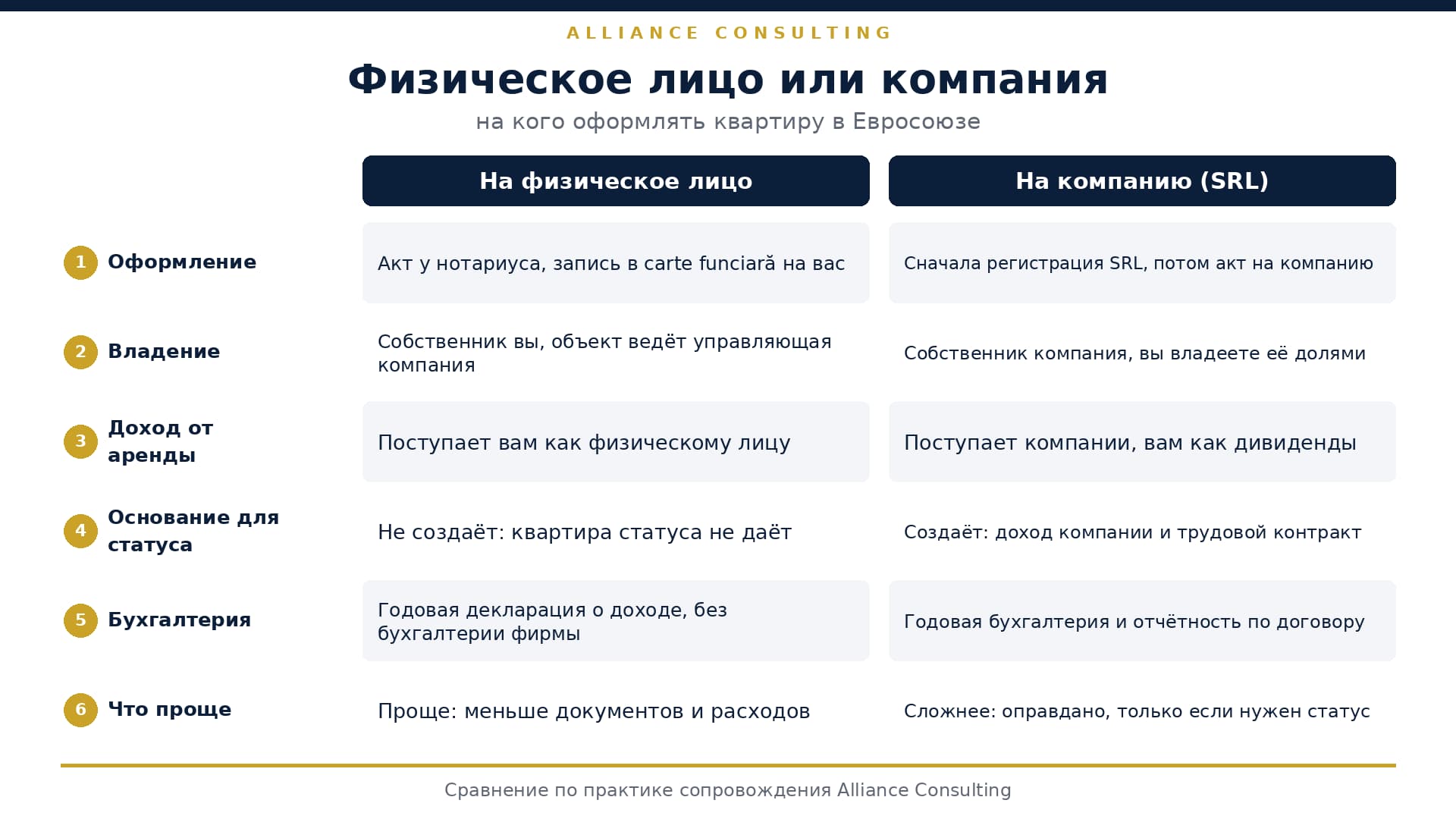
An apartment needed as property, income and a reserve is registered to you as an individual; only an apartment on which status is built is registered to a company. The difference lies in the 6 points below. An SRL is a limited liability company under Romanian law. A comparison based on Alliance Consulting's support practice:
Registration — as an individual: a deed at the notary, an entry in the carte funciară in your name; to a company (SRL): first registering the SRL, then a deed in the company's name.
Ownership — as an individual: you are the owner, and the property is run by a management company; to a company: the company is the owner, and you own its shares.
Rental income — as an individual: it comes to you as an individual; to a company: it comes to the company, and to you as dividends.
Ground for status — as an individual: it does not create one, the apartment does not give status; to a company: it creates one — the company's income and an employment contract.
Accounting — as an individual: an annual income tax return, without company bookkeeping; to a company: annual bookkeeping and reporting under a contract.
Which is simpler — as an individual: simpler, fewer documents and costs; to a company: more complex, justified only if you need status.
When a company is needed for an apartment in the European Union
A company is needed in two cases: when rental income has to go to a company and when status is built on that income. The apartment by itself does not give status — the ground is created by the contract and the company's income, and the decision is made by the authority. The structure is four elements and a result, strictly in order:
registering an SRL;
the apartment is registered to the company;
the rental gives the company officially declared income;
an employment contract with your own company;
the result — a residence permit on the basis of this contract.
You do not need to run the company yourself: a management company runs the property and the tenant, an audit firm handles the bookkeeping and reporting, and a specialized law firm handles the contracts and registrations; each works under a contract with timelines, an amount and a procedure. You will need to be present in person once — when the documents for status are submitted, together with a company specialist.
How a purchase as an individual works if you do not come
You do not need to come for the purchase: the deal goes through in person, by power of attorney or through a management company, and in all 3 cases the notarial deed is signed on the day of the deal, and the entry in the carte funciară is made in your name the same day. Installments are provided by the apartment's owner, not by a bank: the amount and the schedule are fixed in the notarial deed, and in practice a mortgage is not issued to a non-resident.
Entry on the terms confirmed as of September 1, 2026: a property of about €100,000, a down payment of 30% — about €30,000 including notary fees and tax, the balance of about €70,000 over 36 months interest-free, a payment of about €1,900 a month. The balance is secured by the seller's legal mortgage.
The seller's legal mortgage is security under Articles 1723 and 2386 of the Romanian Civil Code in the seller's favor until full payment; it is lifted with the last payment. “Without a bank” means without a loan, not bypassing the bank: payment goes from account to account, the receiving bank checks the origin of the money under EU rules, and its answer on your documents is known before the deposit.
The three ways of doing the deal and the installments step by step are in the hub “An apartment in the EU for a Ukrainian”, a bank refusal in the article “Mortgage refused by the bank”, and the documents for €30,000 in the article “Proof of the origin of funds”.
What to do if the apartment was registered to a friend with citizenship or a residence permit
What is registered in someone else's name is someone else's property: according to the entry in the carte funciară, the owner is the person in whose name it is registered (Article 885 of the Romanian Civil Code), and a verbal agreement does not replace it. Re-registration is possible and is assessed separately — by property, by country and by how the money moved. Start with an assessment, not with a new property.
Such a purchase looks like a solution when you cannot get a mortgage of your own: your friend has citizenship or a residence permit, the bank lends to them, and you make the payments. A year later you have the payments and an agreement, and your friend has the apartment and the loan. The documentary side is checked first, in order:
whose name is in the register and in the loan agreement;
from whose account the payments were made;
whether there is a written agreement about the money.
Then the assessment gives at least two routes: re-registration, if it is possible for the property and under the law of its country, or a new purchase in your name that takes into account the investments already made. An apartment held as an individual in Romania removes the very reason for such a deal: it needs neither a mortgage nor someone else's status. The mistake can be fixed, and the sooner, the cheaper.
How Alliance Consulting works and where to start
Start with a free strategic assessment: a review of your situation, at least two routes — as an individual or through a company — a budget and a sequence of steps. A strategic assessment is a review of the situation before any decisions; it is free and commits you to nothing. The answer comes within 1 business day, and the conversation takes up to 30 minutes.
Armonia shows the properties: selection, a video viewing of the actual property rather than a rendering, the deal. Alliance protects the money and builds the structure: strategy, documents to the bank's requirements, coordination of the notary and the management company, support with status if it is chosen.
All work is done under a contract that sets out the timelines, amounts and procedure; the company's licenses are publicly available on the website. Offices — Constanța, Bulevardul Mamaia 203, and Năvodari.
Questions and answers
Do you need a residence permit to register an apartment in the European Union in your own name?
No, you do not need a residence permit to register an apartment in your own name. Buying a building in Romania is not tied to status — Law 312/2005 restricts only land; for the deal, a valid passport, a proven origin of the money and, if you do not come, a power of attorney are enough. Status is a separate route: it is not a condition of the purchase but an option after it.
Can the apartment later be transferred from an individual to a company?
Yes, an apartment can be transferred from an individual to a company: it is contributed to the capital of your SRL or sold to it. In both cases a new notarial deed and a new entry in the carte funciară are needed, and the costs and tax consequences are calculated in advance. That is why the choice is made before the first deal: re-registering later costs more.
What happens to the apartment if temporary protection ends?
Nothing happens to the apartment: ownership in your name does not depend on status. The entry in the carte funciară is not tied to temporary protection, and the rental goes through a management company. Protection has been extended until March 4, 2028 by EU Council Decision 2026/1912 — this is time for a decision, not a deadline.
Sources
Law No. 312/2005 on the right of foreign citizens, stateless persons and foreign legal entities to land — legislatie.just.ro, Monitorul Oficial No. 1008 of November 14, 2005
Romanian Civil Code, Law No. 287/2009, Articles 693, 885, 1676, 1723, 2386 — legislatie.just.ro, republished in Monitorul Oficial No. 505 of July 15, 2011, in force since October 1, 2011
EU Council Decision 2026/1912 of July 30, 2026 on the extension of temporary protection — eur-lex.europa.eu, Official Journal of the EU of August 4, 2026, in force since August 5, 2026
Law No. 36/1995 on notaries public and notarial activity — legislatie.just.ro, law of May 12, 1995, republished in Monitorul Oficial No. 237 of March 19, 2018
Author: Sergey Valentinovich Kononov, head of Alliance Consulting. Published: 17.09.2026. Updated: 03.10.2026.
Verified as of 02.10.2026. The legal points, amounts and timelines are current as of this date; the page is updated when they change.
Sergey Valentinovich Kononov is the head of the consulting company Alliance Consulting (Constanța, Năvodari). Over 30 years of management experience; the company has run a licensed practice in Romania for four years and supports clients from the first consultation to receiving their documents. The company's licenses and documents are publicly available on the website.